





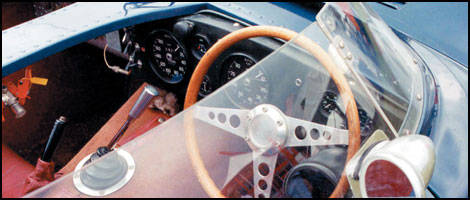
On April 13, 1954, Jaguar's newest prototype completed its initial laps at Silverstone, England. The D-Type, as the successor was logically called, was created by Malcolm Sayer, Jaguar's ace designer and a former Bristol aircraft engineer who had also worked on the C-Type. Applying his aeronautical background, Sayer came up with a monocoque--or unit-body--construction for the new model, with the independent front suspension positioned in place using a complex subframe consisting of tubular-steel rods.
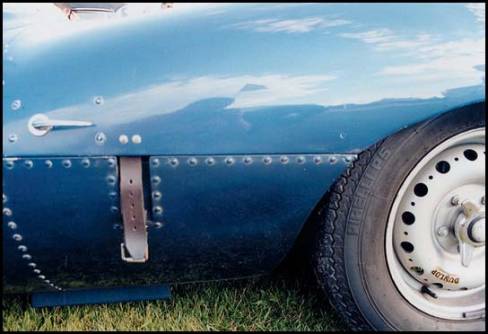
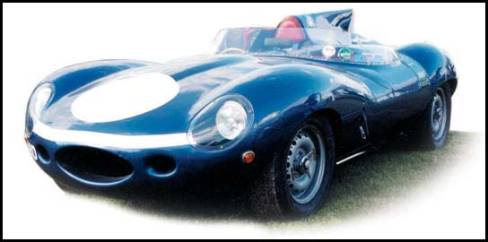
However, it was the streamlined skin that caught everyone's attention. The car appeared virtually seamless, save for a single drivers-side door and a small opening at the rear that contained the spare Dunlop racing tire.
Initially, the D-Type's 3.4-litre DOHC inline six-cylinder engine was similar to that used on the C-Type, but the aerodynamic body and advanced suspension meant it was much faster overall.
In its initial Le Mans outing in 1954, a factory-sponsored D-Type finished second behind the Ferrari of legendary driving ace Juan Manuel Fangio. Despite the loss, the new Jag had proven it had the necessary endurance to match its good looks. It also managed to top 170 mph (270 km/h) on the two-mile (3.2-km) long Le Mans Mulsanne straight, 20 mph (32 km/h) faster than the old C-Type.
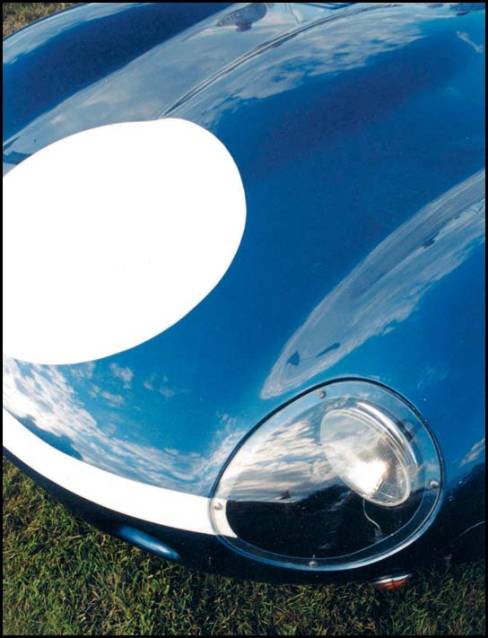
The following year, the D-Type returned to finish first, with the winning car fitted with a longer and more slippery nose and a fuel-injected engine.
As good as the D-Type was on closed circuits such as Le Mans, its delicate structure proved no match for Ferrari or Mercedes-Benz on real-world road courses. The only time a D-Type competed in the Italian Mille Miglia, the car literally came apart at the seams.
In 1956, Jaguar was back competing at Le Mans, but accidents and mechanical failures knocked all three factory entries out of the race. Fortunately, a privately entered D-Type saved the day by securing the victory. This same team also won in 1957 after Jaguar decided to cease all factory-backed racing.
That year, after assembling some 71 D-Types, the company began producing the XKSS, a road-going version of its now-famous race car complete with front and rear bumpers, full windshield, fold-up convertible top, and minus the rear tail fin. Due to a fire at the factory that destroyed most of the leftover D-Type parts used to build the SS, the project was abandoned after only 16 cars had been completed.
The fire put an end to the D-Type, but its legacy prevails. The E-Type (also referred to as the XKE) that began in 1961 was heavily influenced by the car that preceded it. However, it can never replace the original D-Type, nor will it ever earn a shady resting spot on the Earl of March's grounds among the most successful competition cars of all time.
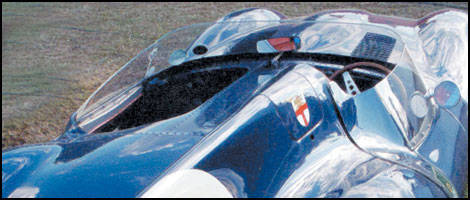 |
However, it was the streamlined skin that caught everyone's attention. The car appeared virtually seamless, save for a single drivers-side door and a small opening at the rear that contained the spare Dunlop racing tire.
Initially, the D-Type's 3.4-litre DOHC inline six-cylinder engine was similar to that used on the C-Type, but the aerodynamic body and advanced suspension meant it was much faster overall.
In its initial Le Mans outing in 1954, a factory-sponsored D-Type finished second behind the Ferrari of legendary driving ace Juan Manuel Fangio. Despite the loss, the new Jag had proven it had the necessary endurance to match its good looks. It also managed to top 170 mph (270 km/h) on the two-mile (3.2-km) long Le Mans Mulsanne straight, 20 mph (32 km/h) faster than the old C-Type.
The following year, the D-Type returned to finish first, with the winning car fitted with a longer and more slippery nose and a fuel-injected engine.
As good as the D-Type was on closed circuits such as Le Mans, its delicate structure proved no match for Ferrari or Mercedes-Benz on real-world road courses. The only time a D-Type competed in the Italian Mille Miglia, the car literally came apart at the seams.
In 1956, Jaguar was back competing at Le Mans, but accidents and mechanical failures knocked all three factory entries out of the race. Fortunately, a privately entered D-Type saved the day by securing the victory. This same team also won in 1957 after Jaguar decided to cease all factory-backed racing.
That year, after assembling some 71 D-Types, the company began producing the XKSS, a road-going version of its now-famous race car complete with front and rear bumpers, full windshield, fold-up convertible top, and minus the rear tail fin. Due to a fire at the factory that destroyed most of the leftover D-Type parts used to build the SS, the project was abandoned after only 16 cars had been completed.
The fire put an end to the D-Type, but its legacy prevails. The E-Type (also referred to as the XKE) that began in 1961 was heavily influenced by the car that preceded it. However, it can never replace the original D-Type, nor will it ever earn a shady resting spot on the Earl of March's grounds among the most successful competition cars of all time.
 |

Article Gallery