


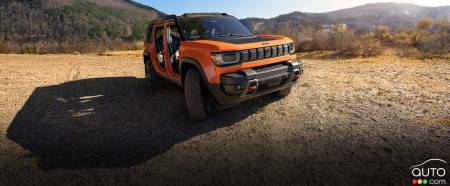



With the launch of the Jeep Recon finally imminent, official Environmental Protection Agency (NHTSA/EPA) range figures for the electric SUV have been released. And they amount to less than what had been promised.
The all-electric SUV is the rough equivalent of the brand’s Wrangler SUV, with its off-road-focused construction and capabilities and overall dimensions. The initial Jeep Recon Moab edition features a massive 100-kWh battery pack, but just as predicted by many in the leadup to the debut of the model, mediocre energy efficiency is resulting in, well, mediocre range.
How mediocre? Even with that big battery, the EPA has rated total range for the Recon at just 222 miles or 357 km on a full charge. Jeep had originally anticipated a slightly higher estimate of 230 miles (370 km).
These numbers sound particularly underwhelming when you compare them with the midsize EV’s future rivals, all of which pack smaller batteries. The base Tesla Model Y All-Wheel Drive is rated for 294 miles (473 km), while the brand-new Rivian R2 Performance AWD delivers an impressive 330 miles (531 km) on a full charge.
Energy inefficiency
The underlying issue is the Recon's energy consumption. According to the EPA data, the electric Jeep uses up a whopping 48 kWh of energy every 100 miles (or 29.8 kWh/100 km). In comparison, the Rivian R2 Performance equipped with 20-inch all-terrain wheels requires only 34 kWh/100 miles (or 21.1 kWh/100 km).
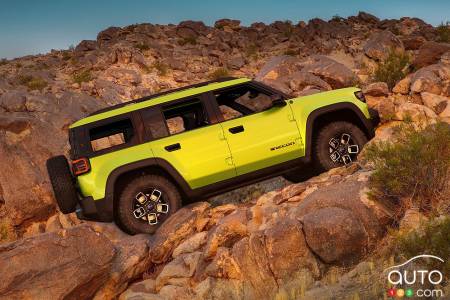
Why so inefficient? Most are pointing the finger at two factors: the Recon is big and heavy, and its design is not particularly aerodynamic. The Recon’s chunky, boxy shape does nothing to reduce drag, and it tips the scales at 6,112 lb (or 2,772 kg). That makes it roughly 450 kg heavier than the Rivian R2 and nearly 725 kg heavier than a Model Y.
Rough & tumble over sleek & aerodynamic
To be sure, the Recon Moab was designed with authentic trail capability as a higher priority than aerodynamic performance. Built on Stellantis’ STLA Large platform, it stands as the only EV in its class equipped with an electronic rear locking differential and removable doors. It also supports rapid charging, juicing from 5 to 80 percent in 28 minutes at a DC fast charger.
Clearly, and understandably, the folks at Jeep were very mindful when developing the Recon that they couldn’t afford to turn off traditional Wrangler buyers in the name of making an optimally performing EV (call it the Ferrari Luce dilemma). But there will be potential buyers looking at the numbers of the Recon and the Rivian R2 side-by-side and wondering why they should go for the Jeep, exactly.
Lacklustre range figures aren’t the only cloud on the horizon as the Recon readies to hit the market. In Canada, the premium Moab edition starts at an MSRP of $84,995 CAD, which climbs to $87,790 CAD on the official website once mandatory fees are tacked on. Flirting with $100,000 CAD after taxes, this low-range adventurer faces a steep uphill battle to win over consumers.