


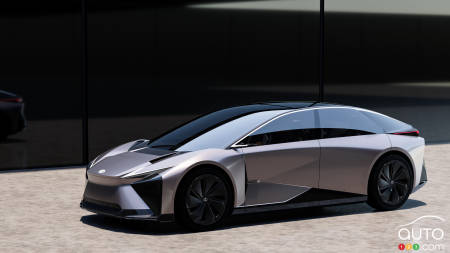



In a pivot reflecting cooling global demand for battery-electric passenger cars, Lexus has cancelled development of its planned electric sedan. The low-slung, futuristic fastback, to be based on the LF-ZC concept, was widely seen as an electric successor to the IS luxury sport sedan. The idea was for it to serve as the flagship cornerstone for the brand’s next-generation EV portfolio. That’s no longer the idea.
As first reported by Japanese outlet Nikkei, an internal corporate review led to the decision to pull away from the ambitious timeline Toyota first established at the 2023 Japan Mobility Show. That called for a 2026 launch of the Lexus EV; it was later pushed to mid-2027. Now, the dedicated EV program as now been scrapped entirely.
Toyota cited shifting market demands and the massive engineering workload associated with the vehicle’s specialized production planning as core reasons for the termination.
By all accounts, the electric IS project was fairly well advanced. Positioned to rival the BMW i3 and the Mercedes-Benz C-Class EV, the sedan was engineered to incorporate massive gigacasted chassis pieces to reduce weight and complexity. Top variants were targeted to produce 500 hp and achieve an unprecedented single-charge range of 1,000 km, triggering widespread industry speculation that the model would debut Toyota’s long-gestating solid-state battery technology.
What now?
Lexus is pivoting its resources toward high-riding crossovers and SUVs, a safer bet than sedans. Product overlap also played a role; the brand already satisfies traditional three-box sedan buyers with its newly introduced ES, available in both hybrid and fully electric configurations and featuring a native NACS port. Lexus also recently expanded its utility lineup with the three-row TZ crossover.
Leveraging existing multi-powertrain platforms like the TNGA-K architecture allows the automaker to protect profitability from launch while maintaining assembly line flexibility. It also aligns with corporate reality: despite a 31-percent year-over-year surge in global EV sales to 188,785 units for the fiscal year ending March 31, battery-electric vehicles still account for a meager 1.8 percent of Toyota’s total worldwide volume of 10.48 million vehicles.
While the LF-ZC project is dead, its engineering legacy will survive. Toyota confirmed that the manufacturing lessons and aerodynamic design elements pioneered during development will migrate into future battery-electric programs, including a next-generation Corolla study.
That all makes sense – why throw away expertise and engineering advances acquired through sweat and toil and heavy investments, after all. But the fact is, the premium brand’s grand vision to sell one million EVs annually by 2030 has officially been put on the back burner.