





"Our new 3.5-litre V6 coupled with an advanced six-speed automatic provides an innovative solution for better fuel efficiency,
more refinement, more power and clean emissions, without any sacrifices," says Barb Samardzich, Ford vice president of Powertrain Operations.
The engine, a 60-degree V6 comprised of an aluminum block and heads, 4-valves per cylinder and DOHC technology, of course, plus intake variable camshaft timing, was developed at Ford's Beech Daly Technical Center. This is a state of the art facility, incidentally, with some of the most advanced prototype development hardware that the auto industry has to offer, some of which does not exist at any rival auto manufacturer's facility. The 3.5 is to be produced at the Lima Engine Plant, in Ohio. As would be expected, it's an extremely advanced
example of modern engineering that should quickly raise Lincoln's credibility among luxury car buyers.
Some of the Duratec 35's high-tech components include cracked-powder metal connecting rods, a composite split plenum intake manifold, an electronic throttle body, high-temperature cast aluminum pistons with low-friction coated skirts and low-tension rings, shimless bucket tappets, centrally located spark plugs, etc.
To those not up on techno-gab, all the aforementioned engine parts add up to what is expected to be relatively efficient fuel consumption, as well as PZEV capable emissions plus hybrid adaptability.
Ford wouldn't make a new engine that wasn't hybrid ready, being that it is the undisputed domestic leader in
HEVs, so expect Lincoln to offer an alternativepowertrain in its MKZ just like Ford will soon incorporate a hybrid-electric drivetrain in its Fusion - which shares underpinnings with the MKZ. Ford plans on producing 250,000 HEVs per year by 2010. It only makes sense that Lincoln's entry-level sedan will get the electric treatment, especially considering Lexus' new ES 350 will incorporate its Hybrid Synergy Drive system shortly. But nevertheless, even without electrical boost, the new 3.5 is quite efficient.
"The 3.5-litre V6 is capable of achieving PZEV certification by delivering low cold-start emissions and enabling rapid catalyst light-off, which is a significant accomplishment for a larger displacement V6 engine," stated Tom McCarthy, engine systems manager for the 3.5-litre V6 engine program.
Ford confidently claims its high compression 3.5 is extremely smooth-running thanks to a low vibration valve-train, for one, plus reduced powertrain bending, a high-tech term for engine block stiffness, the
result of a high pressure die casting method of construction. It reportedly delivers great off-the-line acceleration and more than enough power during passing maneuvers. Additional emissions concerns have been addressed also, with special attention paid to reducing toxins during cold startup.
The electronically shift controlled transmission also features a variable displacement pump, which matches the amount of fluid that gets pushed through the transmission to driver demand, again making it more efficient.
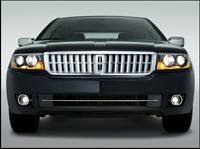 |
| The MKZ looks a little sportier than the Zephyr, thanks to more distinctive headlights. (Photo: Ford Motor Company of Canada) |
The engine, a 60-degree V6 comprised of an aluminum block and heads, 4-valves per cylinder and DOHC technology, of course, plus intake variable camshaft timing, was developed at Ford's Beech Daly Technical Center. This is a state of the art facility, incidentally, with some of the most advanced prototype development hardware that the auto industry has to offer, some of which does not exist at any rival auto manufacturer's facility. The 3.5 is to be produced at the Lima Engine Plant, in Ohio. As would be expected, it's an extremely advanced
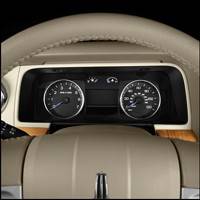 |
| More power will make all the difference, raising the entry-level Lincoln's profile amongst premium sedan buyers. (Photo: Ford Motor Company of Canada) |
Some of the Duratec 35's high-tech components include cracked-powder metal connecting rods, a composite split plenum intake manifold, an electronic throttle body, high-temperature cast aluminum pistons with low-friction coated skirts and low-tension rings, shimless bucket tappets, centrally located spark plugs, etc.
To those not up on techno-gab, all the aforementioned engine parts add up to what is expected to be relatively efficient fuel consumption, as well as PZEV capable emissions plus hybrid adaptability.
Ford wouldn't make a new engine that wasn't hybrid ready, being that it is the undisputed domestic leader in
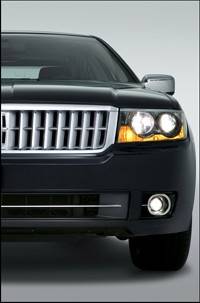 |
| Behind the new grille is a much more powerful 3.5L V6, that sports 250-hp and 240 lb-ft of torque. (Photo: Ford Motor Company of Canada) |
"The 3.5-litre V6 is capable of achieving PZEV certification by delivering low cold-start emissions and enabling rapid catalyst light-off, which is a significant accomplishment for a larger displacement V6 engine," stated Tom McCarthy, engine systems manager for the 3.5-litre V6 engine program.
Ford confidently claims its high compression 3.5 is extremely smooth-running thanks to a low vibration valve-train, for one, plus reduced powertrain bending, a high-tech term for engine block stiffness, the
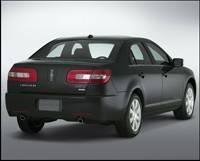 |
| Twin tailpipes free up exhaust flow, reducing emissions while increasing engine efficiency. (Photo: Ford Motor Company of Canada) |
The electronically shift controlled transmission also features a variable displacement pump, which matches the amount of fluid that gets pushed through the transmission to driver demand, again making it more efficient.