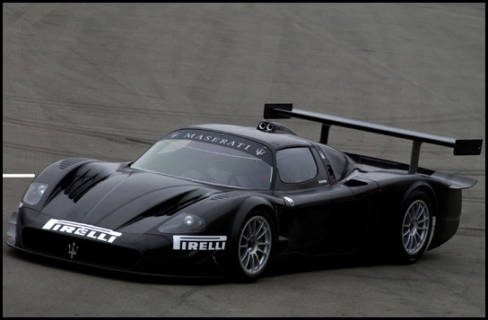
The car has a carbon chassis, with a total weight of 1100 kg, and features what Maserati calls ''interesting aerodynamics.'' Indeed.
The MCC uses a welded steel push-rod suspension and is fitted with Pirelli PZero tyres.
For motive power, the MCC uses a 65-degree, 6-litre V12 coupled to a six-speed sequential manual gearbox. ''This type of layout has been a trademark of Maserati's racing history,'' Dalmonte explains.
The company produced its first 12-cylinder engine (a 60-degree V) in 1956 and it made its Formula 1 debut the following year in the 250F that won the F1 World Championship with Juan Manuel Fangio.
''The Tipo 2 (2491 cc) was an example of the very latest technology of the era,'' Dalmonte says, and ''10 years after it was built it was still competitive, through various evolutions, all with a three-litre capacity.''
In 1961, the Tipo 58 was mounted on the Birdcage Tipo 63, which competed in the 24 Hours of Le Mans.
The Tipo 9 and Tipo 10 were both used in Cooper chassis that won the 1966 Mexican Grand Prix with John Surtees and the 1967 South African Grand Prix with Pedro Rodriguez.
Only the 1493 cc Tipo 8, which was developed in 1961, did not get past the experimental stage, Dalmonte says.