


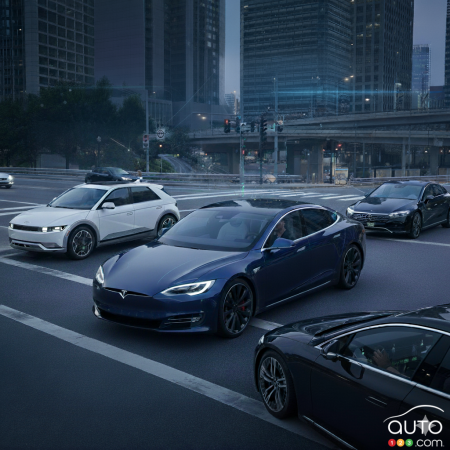



Electric vehicles have achieved a remarkable safety milestone in 2025, with nine models earning the Insurance Institute for Highway Safety's prestigious Top Safety Pick+ award despite significantly tougher testing standards. EVs demonstrate 40% lower injury rates compared to traditional gasoline vehicles, according to IIHS data, while advanced battery protection systems and AI-powered safety features are setting new benchmarks for crash prevention and occupant protection. The latest testing reveals that modern electric vehicles combine superior structural design with cutting-edge technology to deliver unprecedented safety performance.
Hyundai and Kia dominate 2025 safety awards
Korean automakers have emerged as safety leaders in the electric vehicle segment, with the Hyundai Ioniq 5, Ioniq 6, and Kia EV9 all earning IIHS Top Safety Pick+ designations.

The Ioniq 5 excels with its E-GMP platform that integrates battery protection into the vehicle's structural design, creating a reinforced floor structure that distributes impact forces efficiently. This small SUV scored "Good" ratings across all crash tests, including the newly updated moderate overlap front test that now evaluates rear-seat passenger safety.
The Ioniq 6 sedan showcases how aerodynamic efficiency and safety can coexist, featuring Highway Driving Assist 2 with navigation-based adaptive cruise control and hands-on detection for enhanced driver monitoring. Both Hyundai models incorporate Forward Collision-Avoidance Assist with enhanced pedestrian and cyclist detection, actively steering around obstacles when braking alone isn't sufficient. The system uses 15 sensors to create 360-degree awareness, processing environmental data in real-time to predict and prevent potential collisions.
Kia's three-row EV9 proves that family-sized electric SUVs can achieve top safety ratings without compromise. Beyond earning perfect crash test scores, the EV9 features Emergency Evasive Steering Assist that can perform autonomous collision avoidance maneuvers, while its nine airbags provide comprehensive protection for all three rows of passengers. The vehicle's ultra-high tensile steel construction and strategic placement of the battery pack create a protective cage that exceeds federal safety requirements.


Tesla Model Y maintains excellence amid tougher standards
Despite IIHS implementing the strictest testing criteria to date for 2025, the Tesla Model Y secured its fifth consecutive Top Safety Pick+ award, demonstrating consistent safety excellence. Tesla's latest innovation involves Vision-Enhanced Airbags that use cameras to predict frontal crashes and deploy protection earlier than traditional sensor-based systems.
This predictive technology, introduced through the 2025.32.3 software update, represents a breakthrough in proactive safety systems.
The Model Y benefits from Tesla's patented side sill structure that absorbs impact energy while protecting the battery pack during side collisions. The vehicle's ultra-low center of gravity reduces rollover risk by up to 50% compared to traditional SUVs, while the large front and rear crumple zones—made possible by the absence of an engine—provide exceptional energy absorption during crashes. Tesla's over-the-air update capability ensures safety systems continuously improve after purchase, with recent updates adding enhanced Autopilot features and obstacle-aware acceleration that prevents drivers from accelerating into detected hazards.
Notably, Tesla vehicles demonstrate exceptional real-world safety performance with one fire incident per 210 million miles traveled, compared to one per 19 million miles for gasoline vehicles. The Model Y's eight-airbag system, combined with its reinforced battery enclosure featuring heat-spreading design, creates multiple layers of protection that have consistently earned five-star ratings from NHTSA.
Premium German engineering meets electric safety innovation
Mercedes-Benz and BMW have redefined luxury electric vehicle safety for 2025, with the Mercedes EQS featuring the world's first certified Level 3 autonomous driving system approved for use in California and Nevada. Drive Pilot allows hands-free, eyes-off driving at speeds up to 60 mph on designated highways, using LiDAR, cameras, and high-precision positioning to navigate safely. The system includes turquoise automated driving lights that visually indicate when autonomous mode is active, enhancing safety awareness for other road users.
The EQS incorporates PRE-SAFE Impulse Side technology that moves occupants away from the impact zone milliseconds before a side collision, while its reinforced battery protection features multi-layer structures beneath the side sills. Mercedes' Emergency Stop Assist can bring the vehicle to a controlled stop if the driver becomes unresponsive, automatically activating hazard lights and unlocking doors for emergency responders.
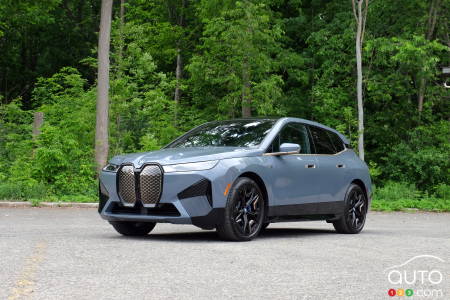
BMW's iX and i4 models showcase the brand's commitment to collaborative safety, featuring Personal Pilot Level 2+ systems that allow hands-free highway driving while maintaining driver engagement. The Highway Assistant operates at speeds up to 85 mph on controlled-access highways, using the Snapdragon Ride Platform for AI-powered perception and planning. BMW's strategic use of advanced high-strength steel in the safety cell, combined with integrated floor reinforcement for battery protection, creates a structure that exceeds crash test requirements while maintaining the driving dynamics the brand is known for.
How modern EV safety prevents serious injuries and deaths
The integration of advanced safety technologies in electric vehicles has fundamentally transformed crash outcomes and injury prevention. Vehicle-to-Vehicle (V2V) communication systems, projected to prevent over 1,000 fatalities annually according to NHTSA, enable cars to "see around corners" and detect hazards up to 300 meters away. This technology, becoming standard in 2025 models, reduces traffic conflicts by 38% when combined with other autonomous features.
Legal experts and safety advocates have noted the profound impact of these advancements on reducing severe injuries. "I see car accidents every day in my practice, and the Vehicle-to-Vehicle communication technology has been a game-changer," notes personal injury attorney George Telquist of Telaré Law out of Washington, who has represented over 5,000 accident victims. "I've witnessed firsthand cases where drivers would have suffered catastrophic injuries or even death from intersection collisions, but the V2V system warned them of an approaching vehicle they couldn't see, allowing them to brake just in time. What could have been a fatal T-bone collision becomes a near-miss or minor fender-bender. It's incredible to see how this technology is preventing the types of devastating injuries that used to be commonplace." The evolution of vehicle safety technology has dramatically changed the landscape of automotive injuries, with modern EVs showing 40% lower injury probability compared to conventional vehicles.
Automatic battery disconnect systems using pyrotechnic "pyrofuses" instantly sever high-voltage connections during crashes, eliminating electrocution risks while preventing thermal events. These systems work in conjunction with AI-driven predictive thermal management that maintains cell temperature variations below 1.5°C, virtually eliminating battery fire risks.
Research shows EVs experience only 25 fires per 100,000 vehicles compared to 1,530 for gasoline cars, contradicting common misconceptions about battery safety.
Ford and Rivian prove American EVs excel at safety

The Ford Mustang Mach-E earned its IIHS Top Safety Pick+ designation while maintaining the performance heritage of the Mustang brand. Ford's Co-Pilot360 suite includes BlueCruise 1.5 hands-free driving capability that operates on over 130,000 miles of pre-qualified highways. The system combines adaptive cruise control with lane centering and automated lane changes, reducing driver fatigue on long journeys while maintaining safety vigilance through driver monitoring cameras.
Rivian's R1S became the first electric adventure SUV to achieve Top Safety Pick+ status, showcasing how off-road capability and safety excellence can coexist. The R1S features 15 inches of ground clearance with air suspension that automatically adjusts for optimal stability, while its quad-motor system provides individual wheel torque management that enhances both traction and accident avoidance. The Rivian Autonomy Platform uses 11 cameras and 5 radars with AI prediction to create comprehensive environmental awareness, enabling features like automatic lane changes and Highway Assist.
Both manufacturers have invested heavily in EV-specific structural innovations, with Ford's Mustang Mach-E featuring optimized crumple zones that provide 30% more energy absorption than traditional designs. Rivian's skateboard platform integrates the battery pack as a structural element, creating unprecedented rigidity while lowering the center of gravity for enhanced stability. These design choices contribute to the vehicles' ability to protect occupants in crashes while preventing accidents through advanced driver assistance systems.
Advanced battery protection sets new safety standards
The 2025 generation of electric vehicles features revolutionary battery protection systems that address both crash safety and thermal management. Multi-layer defense architectures incorporate reinforced enclosures, crush zones with deformable cooling conduits, and strategic placement of ultra-high tensile steel to create protective cages around battery packs. These systems work in conjunction with automated electrical disconnection that isolates high-voltage components within milliseconds of impact detection.
Thermal management has evolved beyond simple cooling to include predictive algorithms that analyze driving patterns and environmental conditions to prevent overheating before it occurs.
Heat dissipation systems now direct thermal events away from passenger cabins through specialized venting mechanisms, while automatic disconnection protocols ensure electrical isolation during any thermal event. The integration of Phase Change Materials (PCM) maintains optimal battery temperatures even during high-performance driving or rapid charging sessions.
Post-crash safety features have become equally sophisticated, with QR codes providing first responders instant access to vehicle-specific safety information, including high-voltage component locations and recommended extraction procedures. Automatic emergency calling systems enhanced with GPS location and impact severity data ensure rapid response times, while fire suppression systems specifically designed for lithium-ion batteries contain and prevent thermal runaway propagation.
Latest crash test results reveal exceptional performance
The Insurance Institute for Highway Safety's 2025 testing protocol represents the most stringent evaluation criteria in the organization's history. The updated moderate overlap front test now includes a rear-seat dummy to assess back-seat passenger protection, while enhanced pedestrian crash prevention testing evaluates systems at higher speeds and more complex scenarios. Despite these tougher standards, nine electric vehicles earned Top Safety Pick+ awards, compared to only 48 total vehicles across all powertrains.
NHTSA's five-star safety ratings for 2025 EVs demonstrate consistent excellence, with models like the Lucid Air achieving perfect scores across frontal crash, side crash, and rollover testing in all variants. The agency's updated testing program for 2026 models will require four core ADAS technologies as standard equipment, pushing manufacturers to democratize safety features previously reserved for premium vehicles. The inclusion of a new pedestrian protection program addresses vulnerable road user safety, recognizing that EVs are involved in 50% more pedestrian and cyclist incidents due to their quiet operation at low speeds.
Euro NCAP testing has similarly validated EV safety performance, with the 2025 Tesla Model 3 earning 93% for child occupant protection and 89% for vulnerable road users. The Audi A6 e-tron achieved 92% for adult occupant protection, demonstrating that electric powertrains enable superior safety cell design without the packaging constraints of traditional engines.
Essential safety features every 2025 EV buyer should prioritize
When evaluating electric vehicles for safety, certain features have proven particularly effective at preventing accidents and protecting occupants. Automatic emergency braking with pedestrian and cyclist detection should be considered non-negotiable, as these systems can reduce rear-end collisions by up to 50%. Look for vehicles with both forward and reverse automatic braking, as parking lot accidents remain surprisingly common despite advanced sensors.
Blind-spot monitoring with active steering intervention goes beyond simple warnings to actively prevent lane-change collisions. The most advanced systems use cameras to display blind-spot views in the instrument cluster or head-up display, providing visual confirmation of surrounding traffic. Combined with rear cross-traffic alert systems that include automatic braking, these features virtually eliminate common intersection and parking accidents.
Advanced driver assistance systems should include adaptive cruise control with stop-and-go capability, reducing fatigue during commutes while maintaining safe following distances. Lane-keeping assist has evolved from simple warning systems to active centering technology that can navigate highway curves, though drivers must remain engaged and ready to take control. The best systems combine multiple technologies into comprehensive suites that work together seamlessly.
Future of EV safety technology promises revolutionary advances
The next generation of electric vehicle safety technology, arriving in late 2025 and 2026 models, will fundamentally transform accident prevention. Vehicle-to-Everything (V2X) communication will become standard, with the global market projected to grow at 42.2% annually through 2030.
This technology enables vehicles to communicate with infrastructure, pedestrians' smartphones, and other vehicles to create a comprehensive safety network that prevents accidents before dangerous situations develop.
Predictive safety systems using artificial intelligence will analyze thousands of data points per second to forecast accident risks minutes before they materialize. These systems consider driver behavior patterns, road conditions, weather data, and traffic flow to suggest route modifications or driving adjustments that prevent dangerous situations. Combined with 5G connectivity, vehicles will share safety-critical information instantaneously, creating collective intelligence that benefits all road users.
Digital twin technology will enable real-time vehicle health monitoring, predicting component failures before they compromise safety. Advanced thermal management systems incorporating AI-driven predictive algorithms will optimize battery performance while ensuring absolute safety, even in extreme conditions. As these technologies mature, the goal of Vision Zero—eliminating traffic fatalities entirely—becomes increasingly achievable through the unique capabilities enabled by electric vehicle platforms.
2025: The Year of 'Smart Safety'
The 2025 model year represents a watershed moment for electric vehicle safety, with manufacturers leveraging the inherent advantages of EV architecture to deliver unprecedented protection levels. From the 40% reduction in injury rates to the revolutionary battery protection systems and AI-powered collision prevention, modern electric vehicles are redefining what consumers should expect from automotive safety. As Korean automakers dominate safety awards while American and German manufacturers push technological boundaries, consumers benefit from intense competition driving rapid innovation.
The integration of advanced driver assistance systems, over-the-air updates, and V2V communication creates vehicles that actively prevent accidents rather than simply protecting occupants when crashes occur. With fire rates 60 times lower than gasoline vehicles and structural designs optimized for both crash protection and battery safety, the data definitively shows that electric vehicles represent the safest choice for modern transportation. As we look toward 2026 and beyond, the continued evolution of EV safety technology promises to save thousands of lives while making our roads safer for all users.