





No more reason to worry
Most people who look at the smart will smile, thinking that they could never fit inside such a small car. Furthermore, many of them still question its safety and crashworthiness. Yet, the automaker (Mercedes-Benz) has built an extremely solid structure that exceeded several European and North American standards in various simulated crash tests.
Safety cell
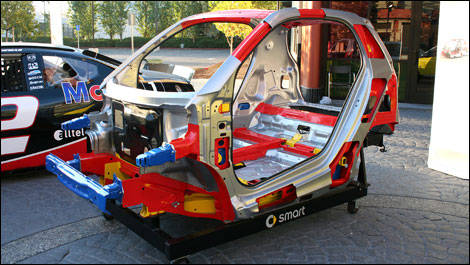
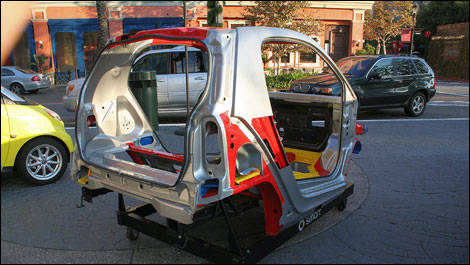
Notice the silver-colored panels on each side of the car? They're actually pillars integrated to the smart's "tridion" safety cell. It starts with the windshield surrounds (front pillars), continues with the roof and ends with the wide rear pillars. On the convertible, the top is obviously absent but the rear pillars still rise up to the original roof level. Made of high-strength steel, these side and traverse members are capable of withstanding high-speed impacts. They are all strategically connected and reinforced to create a tough, integrated safety shell.
Passive and active safety
Each smart sold in Canada comes with next-generation, two-stage front airbags. In addition, Mercedes-Benz Canada wisely added side-impact airbags as part of the standard features. In terms of active safety, ABS brakes and Electronic Stability Program (ESP) are found across the lineup.
Five real-world crash tests
The efforts made to improve passive safety are what impressed me the most. A first test, performed as part of the European New Car Assessment Program (NCAP), involves a 64-kph frontal crash into an offset deformable barrier. Amazingly, the passenger cell remained stable during the impact and virtually intact afterwards.
Two other crash tests are used by Mercedes-Benz for its safety standards. One includes an S-Class (full-size sedan) and a smart colliding at 50 kph in a half frontal crash -- in other words, the left front end of the former hits the left front end of the latter. There were no visible cockpit deformation even at a speed of 100 kph.
Also, a smart was launched at 50 kph sideways to induce two rolls. The convertible model was tested in order to assess the crashworthiness of the A-pillars. As it turned out, they withstood this double impact without ever bending.
Most people who look at the smart will smile, thinking that they could never fit inside such a small car. Furthermore, many of them still question its safety and crashworthiness. Yet, the automaker (Mercedes-Benz) has built an extremely solid structure that exceeded several European and North American standards in various simulated crash tests.
Safety cell
Notice the silver-colored panels on each side of the car? They're actually pillars integrated to the smart's "tridion" safety cell. It starts with the windshield surrounds (front pillars), continues with the roof and ends with the wide rear pillars. On the convertible, the top is obviously absent but the rear pillars still rise up to the original roof level. Made of high-strength steel, these side and traverse members are capable of withstanding high-speed impacts. They are all strategically connected and reinforced to create a tough, integrated safety shell.
 |
Passive and active safety
Each smart sold in Canada comes with next-generation, two-stage front airbags. In addition, Mercedes-Benz Canada wisely added side-impact airbags as part of the standard features. In terms of active safety, ABS brakes and Electronic Stability Program (ESP) are found across the lineup.
Five real-world crash tests
The efforts made to improve passive safety are what impressed me the most. A first test, performed as part of the European New Car Assessment Program (NCAP), involves a 64-kph frontal crash into an offset deformable barrier. Amazingly, the passenger cell remained stable during the impact and virtually intact afterwards.
Two other crash tests are used by Mercedes-Benz for its safety standards. One includes an S-Class (full-size sedan) and a smart colliding at 50 kph in a half frontal crash -- in other words, the left front end of the former hits the left front end of the latter. There were no visible cockpit deformation even at a speed of 100 kph.
 |
Also, a smart was launched at 50 kph sideways to induce two rolls. The convertible model was tested in order to assess the crashworthiness of the A-pillars. As it turned out, they withstood this double impact without ever bending.