





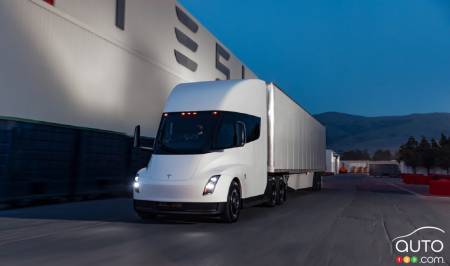
After a gestation period that ranks among the longest in Tesla’s history, the Tesla Semi has finally entered production proper, transitioning from a low-volume pilot project to high-volume assembly.
Tesla confirmed via social media this week that the first Class 8 electric truck had rolled off a new high-volume production line at a dedicated 1.7-million-square-foot facility adjacent to Gigafactory Nevada.

Not in Canada, you say?
As of now, a Canadian launch for the Tesla Semi remains on the horizon but lacks a firm release date. For one thing, Tesla is prioritizing fulfilling its U.S. order backlog and ramping up the Nevada high-volume line.
For another, a primary barrier to entry into Canada is the lack here of specialized Megacharger infrastructure. Currently, no 1.2-MW charging sites are operational in Canada, and until dedicated charging corridors are established along vital stretches like the Windsor-Quebec City trade route, the Semi’s 800-km range remains tethered to private depot charging.
First unveiled in 2017 with an original delivery target of 2019, the Semi program was plagued by years of delays. Until now, only a few hundred units had been hand-built on a pilot line, primarily for Tesla’s internal fleet and pilot partners like PepsiCo and Walmart.
Tesla spent the intervening years refining the design, notably shedding some 1,000 lb from the truck’s weight and updating the exterior to feature a more aerodynamic, Model Y-inspired face.
Powertrain of the Tesla Semi
Tesla has confirmed two distinct variants for the mass-market rollout:
- • Standard Range: Advertised with 325 miles (approx. 523 km) of range.
- • Long Range: Advertised with 500 miles (approx. 800 km) of range.
Says Tesla, those range figures apply while the trucks are fully loaded at a gross combination weight of 82,000 lb.
Power comes from an 800-kW tri-motor powertrain delivering roughly 1,072 hp and designed for longevity. Semi Program Director Dan Priestley stated, in fact, that the batteries are engineered to last one million miles (1.6 million km) in their original duty cycle.
The truck’s efficiency is estimated at 1.7 miles/kWh (approx. 2.7 km/kWh). To support the massive batteries — estimated at roughly 550 kWh and 875 kWh respectively — Tesla is rolling out its Megacharger infrastructure. Supporting speeds of up to 1.2 MW, those stations can replenish 60 percent of the truck's range in roughly 30 minutes.


Tesla Semi pricing
With mass production underway, Tesla aims to undercut the competition on price. The Long Range version is quoted at $290,000, while the Standard Range sits at approximately $260,000, making it the most affordable Class 8 battery-electric tractor currently on the U.S. market.
Note of course that since Tesla hasn’t officially launched the Semi in Canada yet, there’s no official Canadian pricing to be announced. Theoretically, though, those U.S. pricing would translate to roughly $355,000 CAD and $395,000 CAD for the Standard and Long Range models, respectively.
Outlook for 2026
The Nevada facility is designed for an eventual annual capacity of 50,000 trucks, though the ramp-up will be gradual. Demand appears high; in California’s "Clean Truck & Bus Voucher" program, the Semi accounted for over 90 percent of applications between early 2025 and early 2026.
With mass production finally a reality, Tesla expects the first high-volume customer deliveries to begin later this year.