





Less popular with buyers, though, was the loss of power that resulted from the new emission controls that became mandatory on all new vehicles beginning in the late 1960s. To meet these anti-pollution requirements, Triumph was forced to replaced the TR6's export model's fuel-injection system with a pair of Stromberg side-draft carburetors. The result was an output of slightly more than 100 horsepower, a significant reduction compared to the home market's 152-horsepower rating.
Performance also suffered, with a 10-second-plus 0-60 m.p.h. time, nearly two seconds slower than the proper British fuel-injected version.
Despite this power shortage, the TR6 was still considered a lively performer and its low center of gravity, four-wheel independent suspension and front disc brakes resulted in the car earning high marks in the fun-to-drive department. The cockpit was also a comfortable and cosy spot with plenty of leg, shoulder and elbow room for two.
But the real magic began when the engine was turned on, the four-speed gearbox was snicked into first and the relatively heavy clutch pedal was returned to the rest position. The burbling exhaust note emanating from the TR6 was sweet music to both passengers and passers by.
On the down side, the TR6's minimal rear suspension travel resulted in much bottoming-out over rough or even moderately uneven pavement, transmitting a jarring thud through the driver's lower back. Also, the folding soft top (a removable fiberglass hard top was optional), although easier to erect than that of the MGB, still fell short of the class-leading Fiat 124's one-piece instant up/down lid.
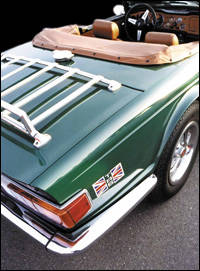
By 1973, British Leyland was forced to add two grotesque chunks of rubber attached to the far end of each of the TR6's front and rear bumpers in order to satisfy the ever-tightening North American safety regulations. Although they provided a measure of protection from mild trauma, they interrupted the car's otherwise clean and graceful lines.
After a seven-year production run, the last TR6 rolled out of the Canley, England plant in July, 1976. Its replacement, the TR7, was a thoroughly modernized sports car, with unit body construction, aerodynamic styling and trendy pop-up headlights. The new model was a popular seller, but its buzzy four-cylinder powerplant meant it lacked the heart and soul of the more muscular looking (and sounding) TR6.
Somehow, I can't imagine the hard-charging Chicken Man driving anything but.
photo:Malcolm Gunn
 |
Despite this power shortage, the TR6 was still considered a lively performer and its low center of gravity, four-wheel independent suspension and front disc brakes resulted in the car earning high marks in the fun-to-drive department. The cockpit was also a comfortable and cosy spot with plenty of leg, shoulder and elbow room for two.
But the real magic began when the engine was turned on, the four-speed gearbox was snicked into first and the relatively heavy clutch pedal was returned to the rest position. The burbling exhaust note emanating from the TR6 was sweet music to both passengers and passers by.
On the down side, the TR6's minimal rear suspension travel resulted in much bottoming-out over rough or even moderately uneven pavement, transmitting a jarring thud through the driver's lower back. Also, the folding soft top (a removable fiberglass hard top was optional), although easier to erect than that of the MGB, still fell short of the class-leading Fiat 124's one-piece instant up/down lid.
By 1973, British Leyland was forced to add two grotesque chunks of rubber attached to the far end of each of the TR6's front and rear bumpers in order to satisfy the ever-tightening North American safety regulations. Although they provided a measure of protection from mild trauma, they interrupted the car's otherwise clean and graceful lines.
After a seven-year production run, the last TR6 rolled out of the Canley, England plant in July, 1976. Its replacement, the TR7, was a thoroughly modernized sports car, with unit body construction, aerodynamic styling and trendy pop-up headlights. The new model was a popular seller, but its buzzy four-cylinder powerplant meant it lacked the heart and soul of the more muscular looking (and sounding) TR6.
Somehow, I can't imagine the hard-charging Chicken Man driving anything but.
photo:Malcolm Gunn