





"This technology helps us take an important step towards our long-term vision of designing cars that do not crash. Our aim for 2020 is that no-one should be killed or seriously injured in a Volvo."
First a warning, then automatic braking
Collision Warning with Full Auto Brake and Pedestrian Safety consists of a new dual-mode radar unit integrated into the car's grille, a camera behind the inside rear-view mirror and a central control unit. The radar and camera continuously monitor the road in front of the car. The radar's task is to detect objects and measure the distance to them. The camera determines what type of objects they are.
In an emergency situation, the driver is first alerted by an audible warning together with a flashing light in the windscreen's head-up display. In order to prompt an immediate, intuitive reaction, the visual warning is designed to look like a brake light coming on. If the driver does not respond to the warning and the system assesses that a collision is imminent, the car's brakes are applied with full braking power.
"Active brake deployment requires that the object is confirmed by both the radar and the camera. Thanks to state-of-the-art sensor technology, it is now possible to engage full braking power," explains Thomas Broberg.
Accidents with pedestrians common in urban traffic
In the EU countries' capital cities, 1,560 people died in road accidents in 2007. Of these, 43 percent were pedestrians. The speed of the car is of considerable significance to the outcome of an accident and the risk of a pedestrian being killed in an accident at 50 kilometres per hour is 85 percent higher compared to if the speed is 25 kilometres per hour.
"Our aim is that this new technology should help the driver avoid collisions with pedestrians at speeds below 25 km/h. If the car is travelling faster, the aim is to reduce the impact speed as much as possible. In most cases, we can reduce the collision force by about 75 percent. Considering the large number of pedestrian fatalities that occur, if we manage to lower the fatality risk by 20 percent this new function will make a big difference. In specific situations the fatality reduction can be up to 85 percent," says Thomas Broberg.
photo:Volvo
First a warning, then automatic braking
Collision Warning with Full Auto Brake and Pedestrian Safety consists of a new dual-mode radar unit integrated into the car's grille, a camera behind the inside rear-view mirror and a central control unit. The radar and camera continuously monitor the road in front of the car. The radar's task is to detect objects and measure the distance to them. The camera determines what type of objects they are.
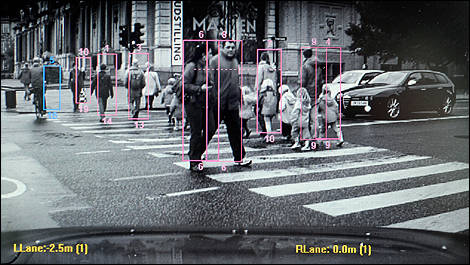 |
In an emergency situation, the driver is first alerted by an audible warning together with a flashing light in the windscreen's head-up display. In order to prompt an immediate, intuitive reaction, the visual warning is designed to look like a brake light coming on. If the driver does not respond to the warning and the system assesses that a collision is imminent, the car's brakes are applied with full braking power.
"Active brake deployment requires that the object is confirmed by both the radar and the camera. Thanks to state-of-the-art sensor technology, it is now possible to engage full braking power," explains Thomas Broberg.
Accidents with pedestrians common in urban traffic
In the EU countries' capital cities, 1,560 people died in road accidents in 2007. Of these, 43 percent were pedestrians. The speed of the car is of considerable significance to the outcome of an accident and the risk of a pedestrian being killed in an accident at 50 kilometres per hour is 85 percent higher compared to if the speed is 25 kilometres per hour.
"Our aim is that this new technology should help the driver avoid collisions with pedestrians at speeds below 25 km/h. If the car is travelling faster, the aim is to reduce the impact speed as much as possible. In most cases, we can reduce the collision force by about 75 percent. Considering the large number of pedestrian fatalities that occur, if we manage to lower the fatality risk by 20 percent this new function will make a big difference. In specific situations the fatality reduction can be up to 85 percent," says Thomas Broberg.
photo:Volvo