





What makes it different? It boasts a new rear differential sporting the world's first electromagnetic operated clutch, making it possible for torque to be distributed not only between the front and rear wheels, but also from side to side between the left and right wheels. A variety of sensors placed throughout the RL gather information about steering angle, speed, lateral Gs, etc., all sent to the on-board ECU, which in-turn disseminates the information
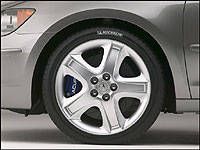 |
| An all-wheel drivetrain has been chosen for the RL to optimize power while minimizing torque-steer. (Photo: Rob Rothwell, Canadian Auto Press) |
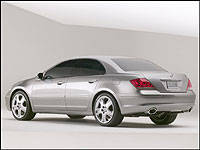 |
| To prevent the rear track from falling out of line around corners, a rear axle acceleration device is built into the new RL. (Photo: Acura Canada) |
But Acura doesn't stop offering innovative solutions with SH-AWD. Making matters even more intriguing, a rear axle acceleration device is built into the new RL. A what? When accelerating through a corner, a car's rear track can often fall out of line as the inside wheels are not rotating as quickly as those on the outside. Jeep had a problem with this when it first introduced full-time four-wheel drive on its old full-size Cherokee. The system, now archaic compared to modern all-wheel drive systems, would stretch its drive chains (chains aren't used anymore) during sharp radius turns on dry surfaces at slow speed, forcing premature replacement. While modern systems don't suffer the same costly consequences, the effect of one side of wheels trying to turn at a different rate than the other side, and not being able to, reduces traction. To compensate, Acura's system accelerates the outside rear wheel faster than the inside one. This in turn creates a constant neutral feel, said to be very accurate in response to a driver's input.