I first took to the track in a silver convertible, top down, engine whining and exhaust gurgling away. The 3.8-litre delivers a
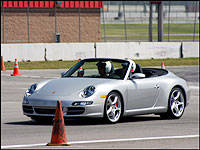 |
| I first took to the track in a silver convertible, top down, engine whining and exhaust gurgling away. (Photo: Trevor Hofmann, Canadian Auto Press) |
more robust note than the 3.6, which should stir the souls of those who like their Porsche's more for go than just show. The drop-top was fitted with an auto gearbox, perfectly suited to the high-speed pursuits I was about to engage in. Among the cars Porsche had made available to test on the track, the Carrera S was the second most powerful, behind the
Carrera GT by some 250+ horsepower. This made looking in the rearview for faster moving traffic less of an issue, allowing me to concentrate on the track ahead, setting up the ideal apex and using trail-braking to make the most of that rear end weight bias.
Not every car reacts like a 911 when entering a corner on
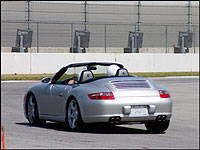 |
| The 911 happens to like a little flick of the binders when taking tight turns, tucking in ever so wonderfully when more weight, and therefore traction is added to the front tires. (Photo: Trevor Hofmann, Canadian Auto Press) |
the brakes. Actually, it's normally a no-no, with most cars happier if you get off the brake pedal before executing a turn. But the 911 happens to like a little flick of the binders when taking tight turns, tucking in ever so wonderfully when more weight, and therefore traction is added to the front tires. I took the opportunity to work on this driving method, something I don't normally get to do, and found with each lap I managed more controlled cornering and better positioning to take on the straights that beckoned me to lay into the throttle.