In case you're concerned about traction with a rear-wheel drive vehicle, the fortwo features Acceleration Skid Control (ASC) to
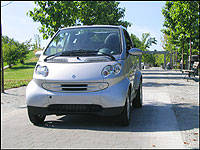 |
| The fortwo was impressively stable on the highway, cruising at 120 km/h comfortably. (Photo: Shawn Pisio, Canadian Auto Press) |
optimize grip on slippery surfaces. Also, remember the Volkswagen Beetle? Its rear-engine rear-drive layout was ideal for snow and muck, a combination that made my father's 1966 version ideal for light-duty off-road expeditions. On the highway, the fortwo was just as impressive, cruising at 120 km/h (75 mph), all the while comfortable, stable and confidence inspiring. Its maximum speed is electronically limited to 135 km/h (84 mph).
I can't say I felt quite as confident tackling twisting "S" curves at higher speeds, but this had more to do with a feeling of tipping, due to its tall, narrow configuration (at 1,537 mm (60.5 in) in width and 1,549 mm (61.0 in) in height it's unusually taller than it is wide),
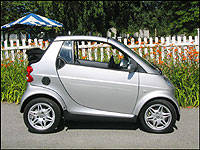 |
| Helped along by 145x65 R 15 front and 175x55 R 15 rear tires and electronic stability program, the fortwo handled winding roads without trouble. (Photo: Shawn Pisio, Canadian Auto Press) |
than an actual tendency to do so. In reality the little gaffer, helped along by 145x65 R 15 front and 175x55 R 15 rear tires, gave me no trouble on winding roads, maneuvering easily without excessive body lean or tire squeal. I never took it to its limit of adhesion, but being that smart has equipped the fortwo with ESP (electronic stability program), my guess is it would manage critical lane changes without too much drama. Would I enter it in a high-speed rally? Definitely not. Do I feel safe driving around the city or making time on the highway? Absolutely. Part or the reason I felt so at ease was due to the smart fortwo's safety record. While smart delivers active safety features such as Brake Assist and ABS as part of its dual-circuit servo-assisted front disc and rear drum braking setup, it also achieves extremely high crash test results.