That engine isn't merely a bored and stroked version of the 5.7-litre lump, mind you, but rather a much more sophisticated piece
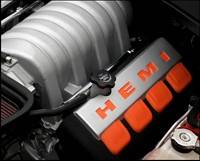 |
| That engine isn't merely a bored and stroked version of the 5.7-litre lump, but rather a much more sophisticated piece of machinery. (Photo: DaimlerChrysler Canada) |
of machinery. In order to extract its high horsepower and torque ratings, the SRT team bored out the "regular" 5.7-litre HEMI's cylinder diameters by 3.5 millimeters apiece, modified the block with reinforcements and increased coolant flow. A forged steel crankshaft was added to minimize vibration, while stronger powder-metal connecting rods, capped off by oil squirter-cooled floating-pin pistons are attached. Also, a modified oil pan was put in place to reduce oil foaming. Additionally, the cams were modified to increase engine speed and effectively produce greater horsepower, increasing the engine's revs by 15 percent to almost 6,200 rpm - the 5.7-litre HEMI hits the limiter at 5,400 rpm. The valve stems were hollowed-out to reduce drag, due to their lighter weight, and then the empty cavities were filled with sodium for dissipating heat more effectively.
New
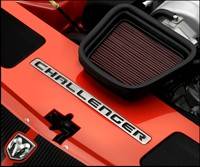 |
| A lot of high-tech goodies were added to improve performance dramatically, resulting in a 4.6 second 0 to 100 km/h sprint time. (Photo: DaimlerChrysler Canada) |
high-flow cylinder heads were added for improved airflow, while larger diameter valves combine with reshaped cylinder ports and a redesigned intake manifold featuring larger diameter runners, for higher-speed tuning. The result of the SRT division's work is a higher revving, quicker turning engine that produces much greater power and torque than the stock 5.7, thanks also to a revised 9.6:1 to 10.3:1compression ratio.
In the end, literally, exhaust headers were attached with "individual tubes encased in a stainless steel shell", allowing yet more engine exhaust flow via large diameter pipes, finished off with quad rectangular tips, just like the original. Not bad for a concept... ahem, prototype.