





For a car enthusiast, the growl from the 6.1-litre HEMI V8 is beyond intoxicating. Truly, it's almost enough to make me want to
watch 45 Tide, Viagra, and lest I forget, Nextel billboards run around in 400 circles on any given Sunday. The pipes are fat and chrome covered, capping off a flat, Kamm-style rear end highlighted by an almost omnipresent deck lid airfoil.
Following its beltline towards the front, the Charger's rear haunches are already athletically designed, curving upward over the rear wheels like the hind legs of a robin-preying tabby ready to pounce. Massive 20-inch five-spoke forged aluminum rims wrap around a set of meaty 245/45/20 front, and 255/45/20 rear Goodyear F1 three-season "boots" with asymmetrical treads, as tires of this size used to be called during the muscle car era of the late '60s and early '70s, now referred to as "shoes" by the latest generation of modern-day performance enthusiasts.
From the front it's a menacing looking beast. An already intensely purposeful
crosshair grille and upwardly canted headlamp assembly gets enhanced with a deep lower valence featuring integrated fogs, while a functional hood scoop doesn't even attempt to hide the unabashed power lying beneath.
Like the 300C SRT8 and Magnum SRT8, the charger finds its motivation from a 425-horsepower 6.1-litre HEMI, backed up with 420 lb-ft of forward thrust. Even with traction and stability control turned off, which is a good idea when on the track so that the ABS-inducing ESP system won't over-apply the brakes and make them too hot for optimal stopping power - and this 4,000 pound sedan needs its brakes to be fully functional - there's ample rear tire to launch quickly without churning up a blue storm cloud of vaporized rubber; although this is easily done with the left foot planted on the brake and right foot "feathering" the throttle.
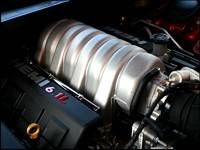 |
| For a car enthusiast, the growl from the 6.1-litre HEMI V8 is beyond intoxicating. (Photo: Trevor Hofmann, Canadian Auto Press) |
Following its beltline towards the front, the Charger's rear haunches are already athletically designed, curving upward over the rear wheels like the hind legs of a robin-preying tabby ready to pounce. Massive 20-inch five-spoke forged aluminum rims wrap around a set of meaty 245/45/20 front, and 255/45/20 rear Goodyear F1 three-season "boots" with asymmetrical treads, as tires of this size used to be called during the muscle car era of the late '60s and early '70s, now referred to as "shoes" by the latest generation of modern-day performance enthusiasts.
From the front it's a menacing looking beast. An already intensely purposeful
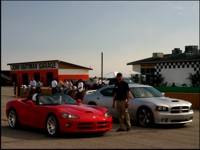 |
| From the front it's a menacing looking beast. (Photo: Trevor Hofmann, Canadian Auto Press) |
Like the 300C SRT8 and Magnum SRT8, the charger finds its motivation from a 425-horsepower 6.1-litre HEMI, backed up with 420 lb-ft of forward thrust. Even with traction and stability control turned off, which is a good idea when on the track so that the ABS-inducing ESP system won't over-apply the brakes and make them too hot for optimal stopping power - and this 4,000 pound sedan needs its brakes to be fully functional - there's ample rear tire to launch quickly without churning up a blue storm cloud of vaporized rubber; although this is easily done with the left foot planted on the brake and right foot "feathering" the throttle.