





 |
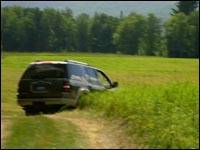
| A large field of tall grass challenged the stability and traction control systems of the various SUVs being tested, before opening up to a short dirt section and then winding pavement. (Photo: Trevor Hofmann, Canadian Auto Press) |
As for favourites, it was a toss-up between Toyota's 4Runner, Jeep's Grand Cherokee and, you guessed it, the new Explorer. What? No Pathfinder in the top three? Actually, I'd put the Pathfinder in last place as far as stability goes. It was bouncy in the woods, slid all over the place uncontrollably on the grass, and was downright scary on the dirt and bumpy pavement sections. Yes, I was equally surprised. Believe it or not, the largish TrailBlazer was much more capable in all segments, especially if a smooth ride counts for anything, but not as agile as the Grand Cherokee, which featured the tightest turn-in and greatest maneuverability. The 4Runner and Explorer soaked up the ruts with less commotion, however, gripped the grass with more confidence, delivered much greater stability on the dirt road section, and both felt completely in control over the tarmac. Yeah, I was surprised with the results too.
Of course, Ford isn't exactly going to put together a test knowing that the Explorer will fail, and in this scenario it ended up shining. I have to admit that the updated Ford feels pretty darn good out on the open road too. This has much to do with its all-new frame, upgraded independent front and rear suspension, and enhanced braking system. The frame design
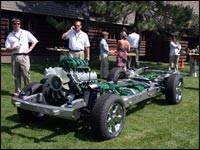 |
| The frame design was inspired by that under the F-150, a fully-boxed, tube-through-tube unit. (Photo: Trevor Hofmann, Canadian Auto Press) |
Gone is the old short- and long-arm rear suspension assembly, now replaced by a lighter independent trailing blade short- and long-arm setup, while the front suspension components are lighter too, featuring upper and lower control arms with a stabilizer bar. All corners get mono-tube shocks, replacing twin-tube units. Even the steering system gets an upgrade, with a new "drooping flow" pump that allows decent control at high-speed, good for the class, yet reduces input levels at low speeds by 15 percent.