





The 24kW lithium-ion battery pack is divided into 4 cells with 48 replaceable modules. Encased in stainless steel, the battery has proved stable and safe through cold-weather testing, and total water immersion. It has a range of 160 km, which more than satisfies the average under-60 km/day commute required by 90% of Canadians (Stats Canada data).
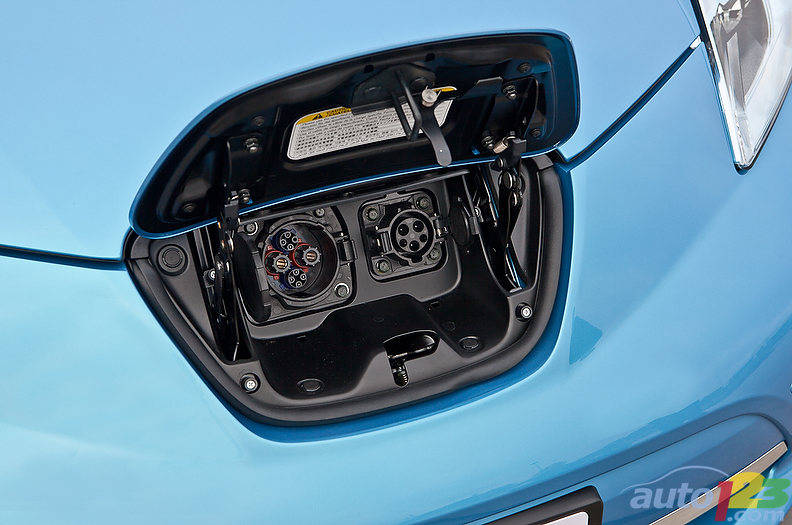
Although it can be plugged into any 110 outlet, it would take 20 hours to fully charge.
At 220 volts, the LEAF can recharge at a more reasonable 8 hours. Home charging stations will be available through the dealerships, can be installed by any qualified electrician and are expected to cost roughly $2,000. A 3-phase industrial charge of 600 volts taking only 30 minutes is expected to be available as the infrastructure develops.
A per-kilometre energy cost figure isn't yet available but it's projected to be 20 – 30% of the cost of fuel (based on 24,000 km, $1/litre fuel and $0.10 kWh for electricity for similarly sized vehicles).
Although U.S. sticker has been set at $32,780, pricing for Canada has not yet been announced.
So far, only Ontario and Quebec are offering incentives; Ontario buyers will receive an $8,500 rebate at point of sale, while those in Quebec will have an $8,000 income tax refund credit.
Supplies of the LEAF will depend entirely on the growth of the infrastructure needed to sustain it. Three provinces; B.C., Ontario and Quebec have signed a "Memorandum of Agreement" signifying their intent to publicly support, and their willingness to work at any barriers, i.e. zoning, that impede the infrastructure development.
The LEAF launches this December in the U.S. while Canadians will have to wait until the fall of next year; mainly due to the winter heating package still being under development.
Although it can be plugged into any 110 outlet, it would take 20 hours to fully charge.
At 220 volts, the LEAF can recharge at a more reasonable 8 hours. Home charging stations will be available through the dealerships, can be installed by any qualified electrician and are expected to cost roughly $2,000. A 3-phase industrial charge of 600 volts taking only 30 minutes is expected to be available as the infrastructure develops.
A per-kilometre energy cost figure isn't yet available but it's projected to be 20 – 30% of the cost of fuel (based on 24,000 km, $1/litre fuel and $0.10 kWh for electricity for similarly sized vehicles).
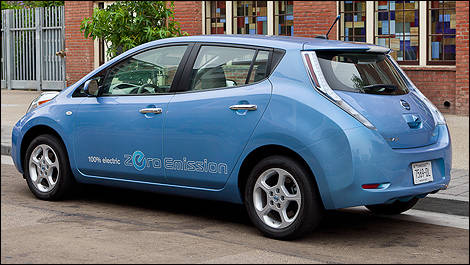 |
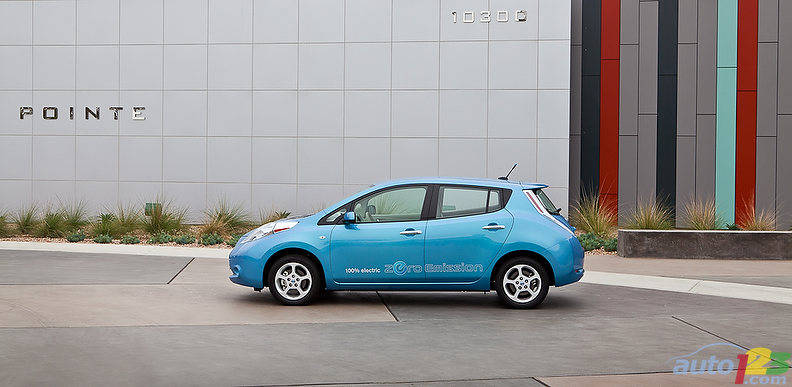
| Ontario buyers will receive an $8,500 rebate at point of sale, while those in Quebec will have an $8,000 income tax refund credit. (Photo: Nissan) |
Although U.S. sticker has been set at $32,780, pricing for Canada has not yet been announced.
So far, only Ontario and Quebec are offering incentives; Ontario buyers will receive an $8,500 rebate at point of sale, while those in Quebec will have an $8,000 income tax refund credit.
Supplies of the LEAF will depend entirely on the growth of the infrastructure needed to sustain it. Three provinces; B.C., Ontario and Quebec have signed a "Memorandum of Agreement" signifying their intent to publicly support, and their willingness to work at any barriers, i.e. zoning, that impede the infrastructure development.
The LEAF launches this December in the U.S. while Canadians will have to wait until the fall of next year; mainly due to the winter heating package still being under development.
Article Gallery