





Ford has just terminated two major battery supply agreements with a combined value of approximately 18 billion dollars in the space of only a few days. To explain the cancellations, the U.S. auto giant cites a sharp slowdown in domestic electric vehicle sales combined with a significant change in the regulatory framework in both the United States and Europe.
The decision comes as demand for EVs falters following the end of U.S. federal tax credits, which returned to buyers of a new electric vehicle up to $7,500 USD.
Two Korean partners affected
The first cancelled agreement, valued at $11.4 billion USD, was with South Korean manufacturer SK On. A few days later, Ford confirmed it is breaking a second contract worth $6.5 billion USD with LG Energy Solution. That deal called for the supply of 34 GWh of batteries between 2026 and 2030, which would have powered some 340,000 electric vehicles per year (based on 100-kWh batteries).
Another separate agreement involving the supply of 75 GWh of batteries produced in Poland for Ford's commercial vehicles in Europe starting in 2027 also appears to be compromised.
In regulatory documents filed in South Korea, LG Energy Solution explains that the cancellation stems from Ford's decision to abandon certain electric models due to recent changes in government policies and a downward revision of sales forecasts.

A major financial impact
The cancellation of the contract with Ford is not insignificant for LG Energy Solution. On its own, this agreement represented approximately one-third of the company's annual turnover in 2024, which suggests significant financial consequences for the supplier.
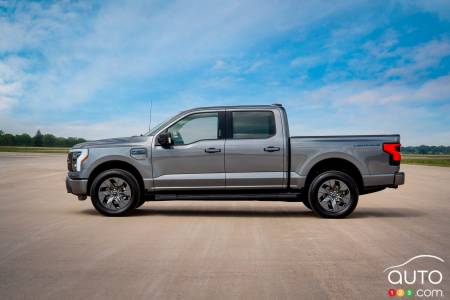
For Ford, the decisions are part of a global revision of its electrification strategy. The automaker has notably halted production of the F-150 Lightning, sales of which dropped sharply in 2025, particularly after the removal of government incentives in the U.S.
Ford revises electric ambitions
Ford CEO Jim Farley acknowledged that EV sales could fall by up to 50 percent in the U.S. over the coming months. This forecast, combined with a loosening of American environmental standards and the looming postponement of the 2035 European deadline for the end of internal combustion engines, is pushing Ford to review its priorities. The manufacturer now intends to focus on its gas and diesel models, which are deemed more profitable in the short term.
Ford does, however, foresee an eventual return of the F-150 Lightning in the form of a new generation equipped with a range extender (internal combustion engine), an approach similar to that announced for the Ram1500 Ramcharger and the upcoming Scout Terra.
The Ford case illustrates the current fragility of the electric vehicle market in North America, which remains heavily dependent on public policies and financial incentives. Without government support, even the manufacturers most committed to electrification must adjust their investments, even if it means postponing their medium-term ambitions.