





Ford isn’t just slowing down its electric vehicle (EV) ambitions; the automaker is completely overhauling its battery strategy. In December, the company terminated two major agreements totaling nearly $18 billion USD: An $11.4 billion joint venture with South Korean company SK On, and a $6.5 billion supply contract with LG Energy Solution.
While several EV projects are being put on ice, Ford is now investing in an entirely different niche: large-scale energy storage.

Bringing CATL’s Chinese technology to Michigan
In 2023, Ford signed a licensing agreement with Chinese giant CATL to utilize its lithium iron phosphate (LFP) chemistry. Originally intended for electric cars, this technology is shifting focus: CATL’s LFP cells will now power stationary storage units for the North American power grid.
These will be produced at a new plant in Michigan, scheduled to open next year.
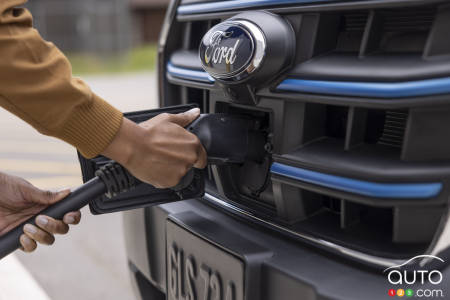
According to Lisa Drake, Ford’s VP of EV programs and energy supply chain, it would have taken the company a decade to reach CATL's level of performance in LFP batteries on its own.
From vehicles to the grid
These large-format batteries won’t be installed in F-150 Lightnings, but rather in energy storage units destined for power producers and grid operators.
Ford says it consulted potential customers in the energy sector, and the response was reportedly unanimous: the demand is real. LFP batteries are known for their durability, thermal safety and low cost — qualities that are ideal for stabilizing power grids.
A highly political project
The project was initially rejected by the state of Virginia due to its ties to China. Michigan eventually agreed to host the plant, despite a tense political climate as Washington seeks to reduce American dependence on Chinese technology.
However, Ford maintains that local production under license is preferable to mass-importing batteries made in China, which already dominate the U.S. energy storage sector.
This shift is a clear admission: China holds a considerable technological lead in LFP batteries, and Ford has chosen a pragmatic path. In the short term, the move positions the automaker as a credible player in the North American energy market — a sector poised to explode alongside the growth of renewable energy. However, the long-term consequences of increasing dependency o Chinese technology remain a cause for concern.