





The Geely PR people visibly enjoy fantasy stories. In a press release issued to describe concept cars unveiled at the Beijing auto show, Auto China 2010, they refer to a Chinese fairytale, "Eclosion to Butterfly", to explain that “through painstaking efforts”, those vehicles have come out of their cocoon just in time to have their premiere at the show!
For some years, Geely has been committed to the development of “alternative power systems” (i.e. electric drives) for vehicles, and according to company spokesperson 5 vehicles using those systems will reach mass production within the next two years.
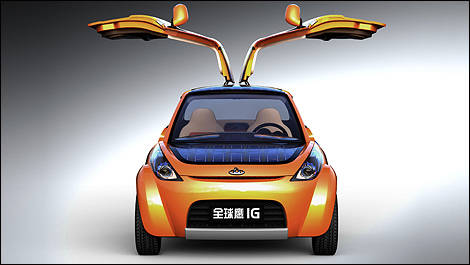
In the mean time, a tiny city hybrid car called IG (for Geel Intelligence) was unveiled at Auto China 2010 to keep consumers’ attention high. This IG is actually an evolution of a concept car bearing the same name and shown in 2009. While the first IG had a single door and 3+1 seating, the new one boasts twin gullwing doors and has a more pratical 2+2 seating layout.
Geely also showed two electric-driven vehicles called EK-1 and EK-2. The first one uses a classic lead-acid battery giving an 80-kilometer range and top speed of 80km/h. The second concept uses a modern lithium-iron-phosphate battery that gives a 180 kilometers range and top speed of 150km/h. The EK-2 battery can also be recharged at 80% within 18 minutes..
 |
| Photo: Geely |
For some years, Geely has been committed to the development of “alternative power systems” (i.e. electric drives) for vehicles, and according to company spokesperson 5 vehicles using those systems will reach mass production within the next two years.
In the mean time, a tiny city hybrid car called IG (for Geel Intelligence) was unveiled at Auto China 2010 to keep consumers’ attention high. This IG is actually an evolution of a concept car bearing the same name and shown in 2009. While the first IG had a single door and 3+1 seating, the new one boasts twin gullwing doors and has a more pratical 2+2 seating layout.
Geely also showed two electric-driven vehicles called EK-1 and EK-2. The first one uses a classic lead-acid battery giving an 80-kilometer range and top speed of 80km/h. The second concept uses a modern lithium-iron-phosphate battery that gives a 180 kilometers range and top speed of 150km/h. The EK-2 battery can also be recharged at 80% within 18 minutes..