





Fate may play a card or two that will change things for everyone concerned, but it looks like future General Motors' consumers will benefit from the company's recent decision to close a bunch of plants and damage the lives of thousands and thousands of its workers and their families.
This is apparently the accepted modus operandi in today's global auto society.
For consumers, it will mean more money for GM to spend on new and improved products and technologies, or so says Rick Wagoner, the company's CEO and chairman.
"I want to emphasize that besides the cost-cutting aspects of our turnaround plan," Wagoner said in making the announcement on Monday morning, adding that "we remain equally committed to the revenue drivers -- introducing great cars and trucks, and executing our revitalized sales and marketing strategy."
GM North America (GMNA) in particular will "continue with its aggressive product assault on all vehicle segments," he said. "To target key growth segments with the right products, GM earlier this year increased capital expenditures, with the vast majority of that increase going toward future car and truck programs. This increased investment will allow GM to average 15 all-new entries a year in the North American market for the foreseeable future."
Wagoner said GM remains "committed to a diversified portfolio of hybrid cars and trucks, including hybrid versions of the Saturn VUE, Chevrolet Malibu, and the next generation of GM full-size pickups and SUVs."
On top of that, he said, GM will also "continue to lead in the implementation of other fuel savings technologies," such as Displacement on Demand and six-speed transmissions. GMNA also will expand its offerings of ethanol-capable vehicles using E85 fuel.
"To help drive additional sales in the future," said Wagoner, "the product plan includes a heavy emphasis on high-growth segments, such as crossovers, compact and luxury SUVs, large pickups and entry-level luxury cars."
Wagoner said there were already signs that GM's product offensive was getting traction with consumers in Canada and the U.S., highlighting such vehicles as the Chevrolet Cobalt, HHR and Impala, Cadillac DTS, Pontiac Solstice, and Buick Lucerne, among others.
He also said that the new full-sized SUVs due to start arriving in January are already being "well received by customers and the media alike."
About a year after the new SUVs from Chevrolet, GMC and Cadillac start to arrive in dealerships, GM will start to show off an entire new lineup of full-size pickups, and the first applications of its two-mode hybrid powertrain.
Wagoner also laid out a strategy "designed to improve significantly the company's performance in the retail marketplace."
This means "strengthening GM's automotive brands, marketing that emphasizes the inherent value of GM cars and trucks, completing GM's distribution channel strategy, and aggressively targeting markets where GM has underperformed against the competition."
For Canada, this likely means a continued avoidance of rebates as the company tries to move consumers to appreciate that the sticker price for a GM product is a fair one that requires neither incentives nor haggling. It also means that we're probably going to more vehicles that the Americans don't get, as Oshawa tries to address the unique nature of the Canadian industry.
photo:GM of Canada
This is apparently the accepted modus operandi in today's global auto society.
 |
| GM CEO Rick Wagoner (Photo: General Motors of Canada) |
"I want to emphasize that besides the cost-cutting aspects of our turnaround plan," Wagoner said in making the announcement on Monday morning, adding that "we remain equally committed to the revenue drivers -- introducing great cars and trucks, and executing our revitalized sales and marketing strategy."
GM North America (GMNA) in particular will "continue with its aggressive product assault on all vehicle segments," he said. "To target key growth segments with the right products, GM earlier this year increased capital expenditures, with the vast majority of that increase going toward future car and truck programs. This increased investment will allow GM to average 15 all-new entries a year in the North American market for the foreseeable future."
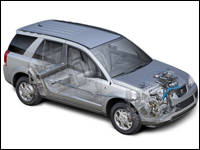 |
| Saturn VUE Green Line (Photo: General Motors of Canada) |
On top of that, he said, GM will also "continue to lead in the implementation of other fuel savings technologies," such as Displacement on Demand and six-speed transmissions. GMNA also will expand its offerings of ethanol-capable vehicles using E85 fuel.
"To help drive additional sales in the future," said Wagoner, "the product plan includes a heavy emphasis on high-growth segments, such as crossovers, compact and luxury SUVs, large pickups and entry-level luxury cars."
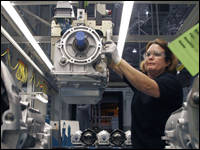 |
| GM 6-speed transmission (Photo: General Motors of Canada) |
He also said that the new full-sized SUVs due to start arriving in January are already being "well received by customers and the media alike."
About a year after the new SUVs from Chevrolet, GMC and Cadillac start to arrive in dealerships, GM will start to show off an entire new lineup of full-size pickups, and the first applications of its two-mode hybrid powertrain.
Wagoner also laid out a strategy "designed to improve significantly the company's performance in the retail marketplace."
 |
| GM Hybrid pickups (Photo: General Motors of Canada) |
For Canada, this likely means a continued avoidance of rebates as the company tries to move consumers to appreciate that the sticker price for a GM product is a fair one that requires neither incentives nor haggling. It also means that we're probably going to more vehicles that the Americans don't get, as Oshawa tries to address the unique nature of the Canadian industry.
photo:GM of Canada