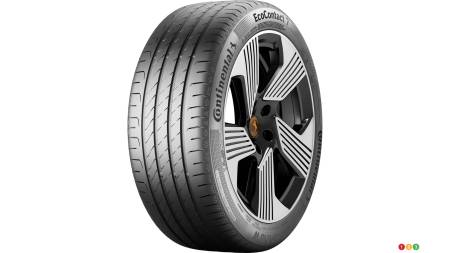



Tire manufacturers are always on the lookout for new technologies and innovations to improve the performance of their products. Continental's new EcoContact 7 and EcoContact 7 S introduce a surprising technology… from the world of golf.
Golf balls, to be precise. In fact, the tires incorporate a key design feature of golf balls.
So what’s that all about?
If you've ever played golf or even just handled a golf ball, you know that balls have dimples. Those little indents are there to improve the aerodynamics of the ball so that it travels farther.
The technology has been proven. Balls with flat surfaces simply cover shorter distances.
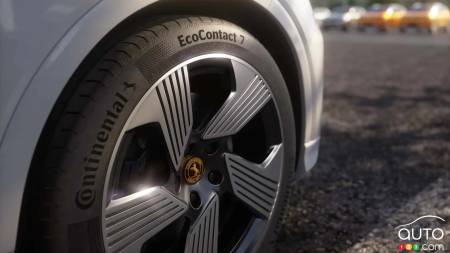
Aerodimples!
Continental took the concept and applied it to this new tire. The name given to the technology is simple: Aerodimples. Hundreds of tiny cells are arranged around the sidewall and the edge of the tread. The manufacturer says this reduces air turbulence behind the tire, which in turn leads to lower energy consumption.
The small curved sections are not the only eco-friendly innovations incorporated into the new tires. The company uses its new Green Chili 3.0 tread compound, designed specifically for low rolling resistance.
With the EcoContact 7 S, which has a sportier vocation, the compound is slightly modified to offer more grip and better handling, especially on wet surfaces.
The inner sections of the tire, meanwhile, use Smart Energy Casing technology, which Continental claims reduces friction, although specific measures were not mentioned. The company also mentions that the tread design helps to reduce rolling resistance while also reducing road noise.
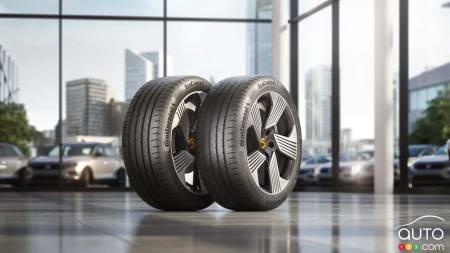
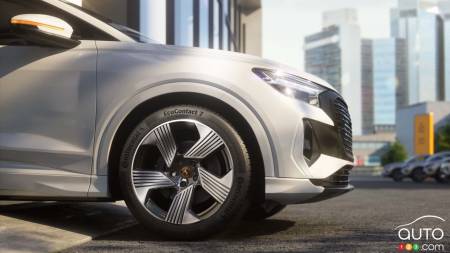
You've probably already guessed that these new tires are designed for electric vehicles, where the slightest difference in air resistance has an impact on range. The tires can, of course, also be used on gasoline-powered models.
For the moment, these summer tires are classified for use in the European Union (category A for rolling resistance and category B for wet braking and road noise).
They have already been approved for use as original equipment on new Volkswagen and Mercedes-Benz models, however, which suggests that they will eventually be offered in North America.