





Gasoline-Electric Hybrid Vehicles
Gasoline-electric hybrid vehicles combine one or more parallel electric motors to assist a normally-aspirated gasoline-powered engine (Toyota Prius) or turbocharged engine (VW Jetta Hybrid). There are two main design philosophies in today’s market. The first uses electricity to reduce fuel consumption and greenhouse gas emissions. The Toyota Prius and Ford Fusion hybrids fall in his category. The second type is those hybrids which use electricity to increase power and torque. The Porsche Cayenne Hybrid and Panamera S Hybrid, among others, fall into this category.
Under the hood of the first category of hybrids is an Atkinson cycle engine that produces less power than a traditional engine with the same displacement as it admits less air and fuel. One or more electric motors, depending on model choice, assist the gasoline engine. The gasoline and electric motors can work together or separately.
In order to run exclusively on electrical power, the vehicle must have a battery pack that is much larger and more expensive than the traditional battery that’s used only to power the starter motor. If some manufacturers choose to stow the battery under the rear seat, as in the Toyota Prius, others choose to use the trunk to store the battery, thus amputating a large amount of cargo room (Hyundai Sonata Hybrid and Ford Fusion Hybrid). These vehicles do not require their owners to plug them in, as they use the gasoline engine and a regenerative brake system to recharge the batteries.
These types of vehicles can run exclusively on electrical power under speeds of 40 to 60 km/h. The distance travelled, in most cases around two kilometres, depends on the capacity of the battery-pack and the regenerative braking system. Furthermore, hybrid vehicles are equipped with stop/start systems that shut down the gasoline engine when at a complete stop. These are the main reasons why hybrid vehicles are at their best in city and stop and go situations.
Those considering purchasing these types of vehicles should keep in mind that most provincial governments offer $500 rebates towards the purchase or lease of these vehicles.
Gasoline-electric hybrid vehicles
Fuel consumption: less than 7 L/100 km
Average CO2 emissions: 2,268 kg/year
Price: less than $40,000
Ford C-Max Hybrid (4.1 L/100 km)
Ford Fusion Hybrid (6.6 L/100 km)
Honda Civic Hybrid (4.4 L/100 km)
Honda CR-Z (5.6 L/100 km)
Honda Insight (4.7 L/100 km)
Hyundai Sonata Hybrid (5.5 L/100 km)
Kia Optima Hybrid (5.6 L/100 km)
Lexus CT 200h (4.5 L/100 km)
Toyota Camry Hybrid (4.7 L/100 km)
Toyota Highlander Hybrid (6.6 L/100 km)
Toyota Prius (3.7 L/100 km)
Toyota Prius c (3.7 L/100 km)
Toyota Prius v (4.3 L/100 km)
2014 Volkswagen Jetta Hybrid (4.4 L/100 km)
Gasoline-electric hybrid vehicles combine one or more parallel electric motors to assist a normally-aspirated gasoline-powered engine (Toyota Prius) or turbocharged engine (VW Jetta Hybrid). There are two main design philosophies in today’s market. The first uses electricity to reduce fuel consumption and greenhouse gas emissions. The Toyota Prius and Ford Fusion hybrids fall in his category. The second type is those hybrids which use electricity to increase power and torque. The Porsche Cayenne Hybrid and Panamera S Hybrid, among others, fall into this category.
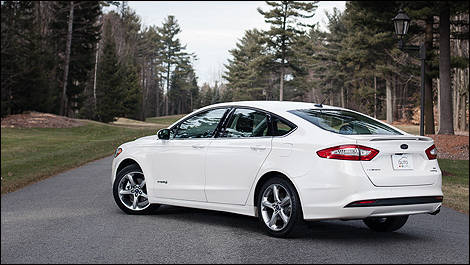 |
| Ford Fusion hybrid (6.6 L/100 km) (Photo: Sébastien D'Amour) |
Under the hood of the first category of hybrids is an Atkinson cycle engine that produces less power than a traditional engine with the same displacement as it admits less air and fuel. One or more electric motors, depending on model choice, assist the gasoline engine. The gasoline and electric motors can work together or separately.
In order to run exclusively on electrical power, the vehicle must have a battery pack that is much larger and more expensive than the traditional battery that’s used only to power the starter motor. If some manufacturers choose to stow the battery under the rear seat, as in the Toyota Prius, others choose to use the trunk to store the battery, thus amputating a large amount of cargo room (Hyundai Sonata Hybrid and Ford Fusion Hybrid). These vehicles do not require their owners to plug them in, as they use the gasoline engine and a regenerative brake system to recharge the batteries.
These types of vehicles can run exclusively on electrical power under speeds of 40 to 60 km/h. The distance travelled, in most cases around two kilometres, depends on the capacity of the battery-pack and the regenerative braking system. Furthermore, hybrid vehicles are equipped with stop/start systems that shut down the gasoline engine when at a complete stop. These are the main reasons why hybrid vehicles are at their best in city and stop and go situations.
Those considering purchasing these types of vehicles should keep in mind that most provincial governments offer $500 rebates towards the purchase or lease of these vehicles.
Gasoline-electric hybrid vehicles
Fuel consumption: less than 7 L/100 km
Average CO2 emissions: 2,268 kg/year
Price: less than $40,000
Ford C-Max Hybrid (4.1 L/100 km)
Ford Fusion Hybrid (6.6 L/100 km)
Honda Civic Hybrid (4.4 L/100 km)
Honda CR-Z (5.6 L/100 km)
Honda Insight (4.7 L/100 km)
Hyundai Sonata Hybrid (5.5 L/100 km)
Kia Optima Hybrid (5.6 L/100 km)
Lexus CT 200h (4.5 L/100 km)
Toyota Camry Hybrid (4.7 L/100 km)
Toyota Highlander Hybrid (6.6 L/100 km)
Toyota Prius (3.7 L/100 km)
Toyota Prius c (3.7 L/100 km)
Toyota Prius v (4.3 L/100 km)
2014 Volkswagen Jetta Hybrid (4.4 L/100 km)