





The Compact Non-Hybrid Gasoline-Powered Economy Cars
The compact non-hybrid gasoline-powered economy car uses a multi-cylinder four-stroke engine that runs by burning an air/fuel mixture ignited by a spark plug in the combustion chamber. Because of its straightforward concept, it remains the most affordable vehicle choice on the market and is the easiest and cheapest to maintain. It also offers the widest range of models.
The growing popularity of hybrid vehicles these past few years has prompted certain manufacturers to work hard to improve their sub-compacts, compacts and even their mid-size vehicles. New technologies have been introduced in order to compete with hybrid offerings:
Direct Injection, uses high-pressure fuel injection in the combustion chamber where it mixes with the air swallowed through the intake valves. This system allows more accurate control of the air/fuel mixture, better combustion, more power and improved fuel economy.
Variable-valve timing, helps vary the moment when valves open and close, as well as the degree in which they open to improve engine output, optimize fuel use and increase power.
Variable cylinder management, allows the deactivation of one out of two cylinders when the engine is running under a light load, at constant highway speeds, or when going downhill or coasting. This system, generally found on V6 and V8 engines, shuts down the valves, the fuel intake, as well as the spark of the de-activated cylinders in order to reduce fuel consumption by as much as 20%.
Multi ratio transmissions, are another way to save precious fuel. Certain manufacturers (most notably Chrysler, BMW, Mercedes-Benz) offer transmissions with 7, 8, and even 9 ratios. The last two ratios are often what is referred to as overdrive ratios, which allow high cruising speeds at low RPM.
The Continuously Variable Transmission, steplessly transfers the energy from the motor while keeping the engine at its ideal operating speed, thus improving performance while reducing fuel consumption.
Flex-fuel engines, can use a variety of fuels. Currently, these types of engines can either burn gasoline or E85 fuel, a mixture of gasoline (15%) and ethanol (85%). Flex-fuel engines reduce fossil fuel consumption, although E85 is not widely available in Canada. Another possibility is the conversion of your present engine to either propane or natural gas, which also reduce greenhouse gas emissions.
Stop/start technology, is similar to that fund on golf carts and is installed on most hybrid vehicles. This technology automatically shuts down the engine when coming to a complete stop and will automatically re-start the engine when the brake pedal is released or at first contact with the accelerator. A number of manufacturers have implemented this technology on their vehicles.
Economical gasoline-engine vehicles
Fuel consumption: less than 8 L/100 km
Average CO2 emissions: 2,848 kg/year
Price: less than $30,000
Chevrolet Cruze (7.2 L/100 km)
Chevrolet Sonic (7.3 L/100 km)
Chevrolet Spark (5.4 L/100 km)
Dodge Dart (7.4 L/100 km)
Fiat 500 (6.7 L/100 km)
Ford Fiesta (6.9 L/100 km)
Ford Focus (7.8 L/100 km)
Honda Civic (7.2 L/100 km)
Honda Fit (7.1 L/100 km)
Hyundai Accent (6.7 L/100 km)
Hyundai Elantra (6.8 L/100 km)
Hyundai Veloster (7.2 L/100 km)
Kia Forte (8 L/100 km)
Kia Rio (6.6 L/100 km)
Mazda2 (6.8 L/100 km)
Mazda3 (7.1 L/100 km)
Mazda CX-5 (7.7 L/100 km)
MINI Cooper (6.8 L/100 km)
MINI Countryman (7.7 L/100 km)
Nissan Cube (7.5 L/100 km)
Nissan Juke (7.5 L/100 km)
Nissan Sentra (7.6 L/100 km)
Nissan Versa (6.7 L/100 km)
Scion iQ (5.5 L/100 km)
Scion xD (7.4 L/100 km)
Smart fortwo (5.8 L/100 km)
Subaru Impreza (7.5 L/100 km)
Toyota Corolla (7.4 L/100 km)
Toyota Matrix (7.7 L/100 km)
Toyota Yaris (6.6 L/100 km)
The compact non-hybrid gasoline-powered economy car uses a multi-cylinder four-stroke engine that runs by burning an air/fuel mixture ignited by a spark plug in the combustion chamber. Because of its straightforward concept, it remains the most affordable vehicle choice on the market and is the easiest and cheapest to maintain. It also offers the widest range of models.
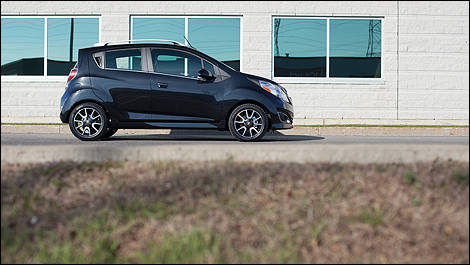 |
| Chevrolet Spark (5.4 L/100 km) (Photo: Sébastien D'Amours) |
The growing popularity of hybrid vehicles these past few years has prompted certain manufacturers to work hard to improve their sub-compacts, compacts and even their mid-size vehicles. New technologies have been introduced in order to compete with hybrid offerings:
Direct Injection, uses high-pressure fuel injection in the combustion chamber where it mixes with the air swallowed through the intake valves. This system allows more accurate control of the air/fuel mixture, better combustion, more power and improved fuel economy.
Variable-valve timing, helps vary the moment when valves open and close, as well as the degree in which they open to improve engine output, optimize fuel use and increase power.
Variable cylinder management, allows the deactivation of one out of two cylinders when the engine is running under a light load, at constant highway speeds, or when going downhill or coasting. This system, generally found on V6 and V8 engines, shuts down the valves, the fuel intake, as well as the spark of the de-activated cylinders in order to reduce fuel consumption by as much as 20%.
Multi ratio transmissions, are another way to save precious fuel. Certain manufacturers (most notably Chrysler, BMW, Mercedes-Benz) offer transmissions with 7, 8, and even 9 ratios. The last two ratios are often what is referred to as overdrive ratios, which allow high cruising speeds at low RPM.
The Continuously Variable Transmission, steplessly transfers the energy from the motor while keeping the engine at its ideal operating speed, thus improving performance while reducing fuel consumption.
Flex-fuel engines, can use a variety of fuels. Currently, these types of engines can either burn gasoline or E85 fuel, a mixture of gasoline (15%) and ethanol (85%). Flex-fuel engines reduce fossil fuel consumption, although E85 is not widely available in Canada. Another possibility is the conversion of your present engine to either propane or natural gas, which also reduce greenhouse gas emissions.
Stop/start technology, is similar to that fund on golf carts and is installed on most hybrid vehicles. This technology automatically shuts down the engine when coming to a complete stop and will automatically re-start the engine when the brake pedal is released or at first contact with the accelerator. A number of manufacturers have implemented this technology on their vehicles.
Economical gasoline-engine vehicles
Fuel consumption: less than 8 L/100 km
Average CO2 emissions: 2,848 kg/year
Price: less than $30,000
Chevrolet Cruze (7.2 L/100 km)
Chevrolet Sonic (7.3 L/100 km)
Chevrolet Spark (5.4 L/100 km)
Dodge Dart (7.4 L/100 km)
Fiat 500 (6.7 L/100 km)
Ford Fiesta (6.9 L/100 km)
Ford Focus (7.8 L/100 km)
Honda Civic (7.2 L/100 km)
Honda Fit (7.1 L/100 km)
Hyundai Accent (6.7 L/100 km)
Hyundai Elantra (6.8 L/100 km)
Hyundai Veloster (7.2 L/100 km)
Kia Forte (8 L/100 km)
Kia Rio (6.6 L/100 km)
Mazda2 (6.8 L/100 km)
Mazda3 (7.1 L/100 km)
Mazda CX-5 (7.7 L/100 km)
MINI Cooper (6.8 L/100 km)
MINI Countryman (7.7 L/100 km)
Nissan Cube (7.5 L/100 km)
Nissan Juke (7.5 L/100 km)
Nissan Sentra (7.6 L/100 km)
Nissan Versa (6.7 L/100 km)
Scion iQ (5.5 L/100 km)
Scion xD (7.4 L/100 km)
Smart fortwo (5.8 L/100 km)
Subaru Impreza (7.5 L/100 km)
Toyota Corolla (7.4 L/100 km)
Toyota Matrix (7.7 L/100 km)
Toyota Yaris (6.6 L/100 km)