





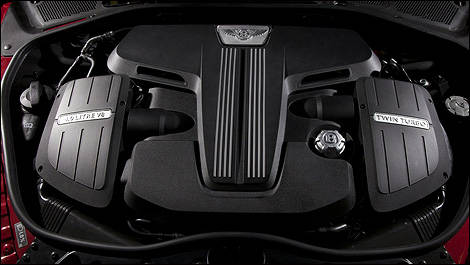
Horsepower is good, but not at the expense of fuel consumption. Well sure, a twin-turbocharged 620-hp Bentley will guzzle an oil tanker’s worth more fuel in a week compared to a 140-hp Honda Civic but, between you and I, we're comparing apples to caviar-stuffed foie gras covered in pure truffle oil...
A while back, I blogged about the fact that V8 engines were a dying breed. If you click on the link, you'll note that I was referring to musclecars. In this blog, I welcome V8s as the new greener alternative. How about that?
Ever notice that the horsepower wars are still ranging on, but in a far different manner and on a whole other level? For years, decades even, displacement was the only way to get power numbers to get the neighbours jealous. These days it's all about turbocharging.
Turbocharging smaller engines to produce same or more power than larger, normally aspirated engine blocks and more cylinders, is the environmentally responsible way to proceed.
This occurs, obviously, not at the expense of pure power. HORSEPOWER!
500 hp. Say it out loud: 5 0 0 h o r s e p o w e r. That's a lot of gusto. That number is now the doorway into the exclusive big-number supercar game. In reality, 600 hp is the new big-boy number. 700 hp regularly bleeps on the radar these days as well. The Veyron’s 1,000+ horses are untouchable for the moment but that will change.
Many of the cars that boast this kind of power are turbocharged or blown. Current exceptions include the Italian Lamborghini and Ferrari brands, Aston Martin and Pagani. Most others are boosted. The McLaren, the Porsche, the Noble and numerous others are going the way of the turbine. To be sure, this is a trend that is trending.
The slowest of these cars reaches 100 km/h in 4.5 seconds, but the real dope is in the fact that a number of these cars consume no more than 12L per 100 km (roughly 20 US mpg) on the highway. That is the direct result of a smaller V8 engine maintaining speed versus a V12. Transmissions have much to do with it all as well.
So I’m sad to say that the V8 is dead but I’m happier to say: Long live the V8, horsepower and fuel economy!
A while back, I blogged about the fact that V8 engines were a dying breed. If you click on the link, you'll note that I was referring to musclecars. In this blog, I welcome V8s as the new greener alternative. How about that?
Ever notice that the horsepower wars are still ranging on, but in a far different manner and on a whole other level? For years, decades even, displacement was the only way to get power numbers to get the neighbours jealous. These days it's all about turbocharging.
 |
| Photo: Bentley |
Turbocharging smaller engines to produce same or more power than larger, normally aspirated engine blocks and more cylinders, is the environmentally responsible way to proceed.
This occurs, obviously, not at the expense of pure power. HORSEPOWER!
500 hp. Say it out loud: 5 0 0 h o r s e p o w e r. That's a lot of gusto. That number is now the doorway into the exclusive big-number supercar game. In reality, 600 hp is the new big-boy number. 700 hp regularly bleeps on the radar these days as well. The Veyron’s 1,000+ horses are untouchable for the moment but that will change.
Many of the cars that boast this kind of power are turbocharged or blown. Current exceptions include the Italian Lamborghini and Ferrari brands, Aston Martin and Pagani. Most others are boosted. The McLaren, the Porsche, the Noble and numerous others are going the way of the turbine. To be sure, this is a trend that is trending.
The slowest of these cars reaches 100 km/h in 4.5 seconds, but the real dope is in the fact that a number of these cars consume no more than 12L per 100 km (roughly 20 US mpg) on the highway. That is the direct result of a smaller V8 engine maintaining speed versus a V12. Transmissions have much to do with it all as well.
So I’m sad to say that the V8 is dead but I’m happier to say: Long live the V8, horsepower and fuel economy!