





He got more than he asked for when it comes to prospective buyers, so what caused the brand's meteoric rise in popularity?
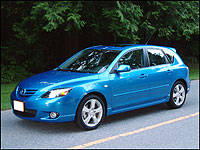 |
| Due to Canadians liking smaller cars than Americans, the Mazda 3 has been a much better seller per capita for the company north of the 49th. (Photo: Rob Rothwell, Canadian Auto Press) |
"Our product lineup is really ideally suited to the Canadian market. Mazda isn't large enough so that it can design a car for all jurisdictions, we benefit from the European influence," said Young.
Specific to the 3, Young explains why it has done so much better per capita in Canada than south of the border, despite the U.S. having a strong year in compact car sales. "Looking at the C-car segment, the U.S. isn't 10 times as big because American consumers have a preference for larger cars," Young commented, adding, "In Canada the ratio is 5 to 1 instead of 10 to 1."
But that statistic could be used to quantify Honda's success with its Civic, or Toyota's with its new Echo Hatchback. More importantly, why has Mazda found such strong success with its new lineup overall? In a nutshell, the automaker hit on a simple formula
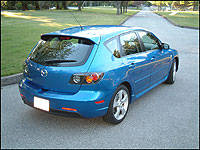 |
| Mazda hit on a simple formula that seems to elude so many rival manufacturers: make a car that performs well, with high quality materials, but don't price them beyond the reach of core buyers. (Photo: Rob Rothwell, Canadian Auto Press) |
While the formula sounds obvious, if it was easy no doubt every automaker would experience one raging success after another. The fact is they don't. Take the previous 626 for example. While the first 626 sedan and European-inspired 5-door were so stylish they set new design trends in the category, somehow the look got homogenized from generation to generation until Mazda's dedicated design team, product planners and executives OK'd the rather bland final iteration. What were they thinking? That's difficult to say, but it hardly matters now that the new replacement 6 is selling so well.