





Auto123.com: Are drivers in Formula 1 any better than the NASCAR drivers?
Steve Hallam: “All great drivers have a unique talent. It is extremely difficult to define what it is. It makes them exceptional in various aspects. Here in the Sprint Cup we have about 15 to 20 drivers that are really good, and a couple that are exceptional. There’s interest from NASCAR drivers towards F1. Unfortunately, the opposite is not true. Europeans don’t realise how different racing is here. Not only that, I think they don’t know it’s happening.”
“A good show is not always linked to the level of technology involved. The Sprint Cup cars are not highly sophisticated but they produce a fantastic show. One of the reasons for that is the telecast. The TV explains everything. And if you look at the garages here, the cars are placed side by side. Two competitors are placed one beside each other. Nothing can be hidden. That’s why the racing is so competitive. I called this “reverted engineering”. You see certain things on other cars, and you have to understand it before you can apply it on your own cars.”
Auto123.com: We hear that racing a full season in the Sprint Cup in a competitive manner require something like $15 to $20 millions. How can you explain that amounts are so high?
Steve Hallam: “The Sprint Cup is relatively expensive because of the scale of the series. We were in California one week, in New Hampshire the next and then in Daytona the other week. Plus we move from a road course to a short oval to a superspeedway. Although the cars look about the same, underneath the skin, they are very different. During one season, we will prepare something like between 35 and 40 cars. In F1, they built 5 or 6 cars for the season.”
“We also do intensive tests in the wind tunnel, where we test full size cars. We basically work on the upper surface of the car as defined by NASCAR rules. On the superspeedways, we need to calibrate the cars, and to reduce drag as much as possible. In terms of aero development, we also work on the underside of the car, on the packaging and give attention to small details that can make a difference. We are blessed to have access to two full size wind tunnels in North Carolina: Windshear in Concord, and Aerodyne in Mooresville.”
Auto123.com: So for you as an engineer, working in the NASCAR environment is as stimulating as it was in Formula 1?
Steve Hallam: “Ultimately, in any category of motorsport, things sums up to four small patches of rubber. Whether it is F1, NASCAR, IndyCar, rallying, karting, whatever, there are only four contact patches of rubber on the ground, and the drivers must use them to their best abilities to make their cars go as fast as possible.”
photo:Autostock & WRI2
Steve Hallam: “All great drivers have a unique talent. It is extremely difficult to define what it is. It makes them exceptional in various aspects. Here in the Sprint Cup we have about 15 to 20 drivers that are really good, and a couple that are exceptional. There’s interest from NASCAR drivers towards F1. Unfortunately, the opposite is not true. Europeans don’t realise how different racing is here. Not only that, I think they don’t know it’s happening.”
“A good show is not always linked to the level of technology involved. The Sprint Cup cars are not highly sophisticated but they produce a fantastic show. One of the reasons for that is the telecast. The TV explains everything. And if you look at the garages here, the cars are placed side by side. Two competitors are placed one beside each other. Nothing can be hidden. That’s why the racing is so competitive. I called this “reverted engineering”. You see certain things on other cars, and you have to understand it before you can apply it on your own cars.”
 |
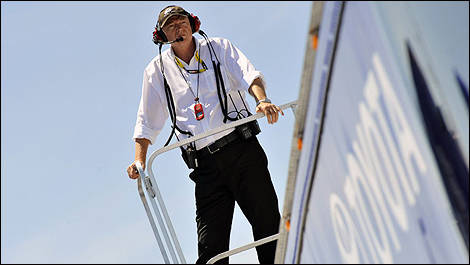
| Steve Hallam with the McLaren Formula 1 team in 2007. |
Auto123.com: We hear that racing a full season in the Sprint Cup in a competitive manner require something like $15 to $20 millions. How can you explain that amounts are so high?
Steve Hallam: “The Sprint Cup is relatively expensive because of the scale of the series. We were in California one week, in New Hampshire the next and then in Daytona the other week. Plus we move from a road course to a short oval to a superspeedway. Although the cars look about the same, underneath the skin, they are very different. During one season, we will prepare something like between 35 and 40 cars. In F1, they built 5 or 6 cars for the season.”
“We also do intensive tests in the wind tunnel, where we test full size cars. We basically work on the upper surface of the car as defined by NASCAR rules. On the superspeedways, we need to calibrate the cars, and to reduce drag as much as possible. In terms of aero development, we also work on the underside of the car, on the packaging and give attention to small details that can make a difference. We are blessed to have access to two full size wind tunnels in North Carolina: Windshear in Concord, and Aerodyne in Mooresville.”
 |
Auto123.com: So for you as an engineer, working in the NASCAR environment is as stimulating as it was in Formula 1?
Steve Hallam: “Ultimately, in any category of motorsport, things sums up to four small patches of rubber. Whether it is F1, NASCAR, IndyCar, rallying, karting, whatever, there are only four contact patches of rubber on the ground, and the drivers must use them to their best abilities to make their cars go as fast as possible.”
photo:Autostock & WRI2