An Urban Ute for All OccasionsHonda's CR-V is the perfect example of what happens when
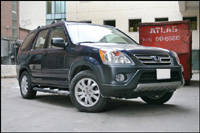 |
| If most CR-Vs will only go this far off road, why bother making it capable to do more? (Photo: Justin Couture, Canadian Auto Press) |
engineers and marketing people work together. It is a compact SUV that was never intended to go off-road, which, when it came out, before the term crossover was even dreamt up, went against the grain. After all, that's what SUVs are generally designed to do. It has never had a ladder-on-frame chassis, nor has it ever had a transfer case (not even an electrical switch-knob type thing). You would think that engineering a product against what, up until the point of its inception, was an SUV's very purpose would flop, but it hasn't. Rather, the CR-V, and the Toyota RAV4 that almost simultaneously joined it on North America's automotive stage, proved that macho qualities aren't needed in order to make an SUV sell well. The effects of these light-duty players, as well as others that have come along since, have caused Suzuki, the originator of the cute 'ute segment, to modify its ladder-frame ways with an all-new combined monocoque-ladder frame in its new Grand Vitara - what many soft-roaders consider a best of both world's scenario.
To
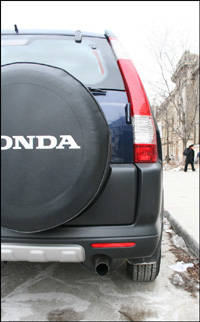 |
| New tail lamps are clear and red. PVC zip-up bag for the spare tire remains on base models. (Photo: Justin Couture, Canadian Auto Press) |
keep things a-bubbling in dealerships and on the streets, Honda has gone and revised the CR-V with a minor refresh, similar to what it did this year with its near full-size Pilot, but, like the Pilot, the facelift was so mild that it will probably go unnoticed; it certainly did in our office, slipping past our radar on vehicles to test last year. If you manage to get face to face with a new 2006 CR-V, however, you can tell it a part from the old model by its grille, which now touts more chrome and an extra spar, not to mention different front and rear bumpers that feature faux-metal trim. Of course, a facelift just wouldn't be a facelift without some changes to the exterior lighting, so the CR-V gets new projector-beam style headlamps and new white and red tail lights with larger cornering indicators.
Honda also simplified your choices when it comes down to buying the CR-V. There are now three models, the base SE (as tested), the EX, and the luxury EX-L, all of which feature Honda's RealTime 4WD as standard. The trim lines are a pretty simple lesson as well - the base SE features most of the basics such as power windows, power mirrors, keyless entry and a CD stereo, not to mention 16-inch alloy wheels, ABS brakes, VSA stability control, a roof rack and a novelty step bar, which is somewhat trivial considering the CR-V isn't all that tall. Stepping up to the EX gives you more extras, although, it's not until the EX-L model that you get heated leather seats, colour-keyed bumpers and a hard-cover case for the tailgate-mounted spare. The EX-L is only available with column-shift automatic, whereas the SE and the EX come standard with a stick.
All CR-Vs are powered by one lone engine, which in fact is the
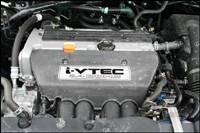 |
| i-VTEC motor is a fine unit indeed, and a good mate to the five-speed manual gearbox. (Photo: Justin Couture, Canadian Auto Press) |
most powerful engine in the CRV's global lineup. Where other jurisdictions are given the choice of an older 140-horsepower 2.0-litre inline-four, or a 2.2-litre diesel, we're blessed with a punchy 156-horsepower 2.4-litre i-VTEC enhanced four-cylinder engine, also featured in the base Accord and Acura's RSX (plus the Canada-only CSX). It's a fantastically smooth and willing powerplant, providing the necessary grunt for dealing with roads that aren't just sloped downwards. Of course, this engine is just blown out of the water by Toyota's excessive 269-horsepower 3.5-litre V6-powered RAV4, but as far as inline-four-powered SUVs, this CR-V is still the one to beat.