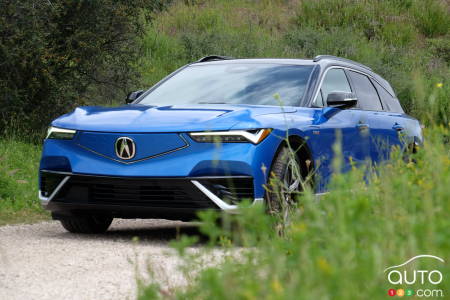
Add Acura's name to the list of automakers open to reviewing their electrification strategy. In fact, for many of them, their plans have been deemed too ambitious internally, considering the pace at which public demand is evolving. As a result, the current strategies are being reviewed.
Acura remains committed to a full electric shift, but a more gradual transition may be on the drawing board.
In 2021, you may recall, Honda's luxury brand said it would quietly abandon hybrid solutions (the NSX was available at the time) to focus on all-electric. At the time, the division's objective was for 60 percent of sales in 2030 to be electric vehicles. But that target is now under review.
Speaking with Automotive News back in January, Mike Langel, Acura's Assistant VP of National Sales in the U.S., acknowledged that the previous target for electric vehicle sales was no longer applicable.

Langel did not confirm the arrival of new hybrid models, but neither dismiss the idea out of hand. “Our long-term plan is to sell all-electric vehicles, but we are very flexible about the form this project will take,” he said.
Automakers don't make these decisions blindly. They observe market trends and adjust accordingly. Demand for electric vehicles continued to grow in 2024, and sales reached their highest level yet. But the pace of growth hasn’t met projections, so automakers are revisiting those projections.
Hybrid models, meanwhile, enjoyed a resurgence in popularity in 2024. At Toyota, hybrids accounted for 40.8 percent of all sales last year.
It’s by no means certain Acura will go ahead with developing hybrid models. It has the advantage of being able to call on the expertise and powertrains produced by parent company Honda, of course. But Acura insists it is pursuing its electrification plan. We already have the ZDX SUV, there the smaller RSX SUV expected next year. It will be the first to be based on the Honda/Acura group’s new electric architecture of the, which will also be used for Honda models.
Acura is still aiming for 100 percent of its sales to come from zero-emission vehicles by 2040.