





As customers demand more and more from their cars, manufacturers have been busy developing high tech features for their powerplants in order to
maximize performance and efficiency. Gone are the days when having a 4 cylinder engine meant taking a hit in performance, or when a big V8 engine meant excessively high fuel consumption. Modern science and engineering have made engines better than ever.
As carmakers extract more and more power out of their engines, you'll likely encounter some of these features when shopping for your next ride. Don't pass them off as just another entry into a brochure full of abbreviations- countless hours of research and development have gone into their creation, and it pays to understand how they help you get more out of your car.
Variable Valve Timing:
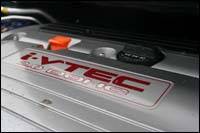
Systems such as VTEC, VVTL-I or CVVT work by altering the valve timing characteristics of an engine, allowing it to offer performance and economy
without losing one for the other. By controlling camshaft profiles and taking control of valve duration and lift, the engine computer can switch between various "modes" depending on driver input.
While cruising along the highway, the engine operates economically, using less fuel. Punch the throttle and the system kicks over into a performance mode, using more fuel but providing more power than an "economy only" engine. Often times the driver will feel a "kick" when the system switches over, and hear an accompanying change in the engines note.
VTEC was the first use of such a system, developed by Honda. Richard Allan, a Honda sales representative, explains "Take the Civic for example. A 1.8 iVTEC engine is standard, delivering 2.0L performance yet 1.5L economy. And it's as reliable as the day is long."
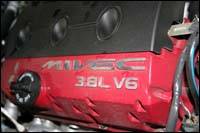
Some other systems include Toyota's Variable Valve Timing and Lift system with Intelligence (VVTLi), and Mitsubishi Innovative Valve Electronic Control (MIVEC). Though the systems operate in different ways and have different names, the idea is the same for each.
Cylinder Deactivation:
GM introduced cylinder de-activation in the 80's to help motorists save on fuel. Problems occurred which took it out of the market shortly thereafter. Seasoned mechanics will remember that in the past, cylinder de-activation was a bit of a disaster, though now it's been perfected.
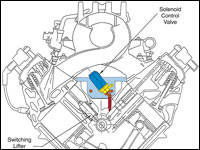
GM's Displacement on Demand system is available on certain models like the Impala SS and Grand Prix GXP. The 5.3 liter V8 engine powering these and other models is able to shut down cylinders selectively when the full 300 horsepower brunt isn't needed. The system works using a valve that causes high-pressure oil to either activate or de-activate the valve lifters. Fuel injection is then cut from the corresponding cylinders. According to GM, the benefit is an increase in fuel economy by as much as 8 percent.
Chrysler's Multi Displacement System, or MDS, is fitted to their 5.7 litre HEMI V8 and works in much the same way. Output is rated at around 340 horsepower, but fuel consumption is only marginally more fuel than the company's 3.5 litre V6 during highway driving. Though the HEMI guzzles at an alarming rate under a heavy foot, the MDS aids in reducing fuel costs for modest drivers, and has won several awards for its innovation.
Honda has a similar system available on its V6 engines.
If you haven't yet tried a vehicle which uses a cylinder deactivation system, it's well worth checking out. Despite some misconceptions, neither GM's or Chrysler's systems ever give a clue that they are switching between 4 and 8 cylinder operation. Both systems are completely and totally invisible to the driver.
 |
| (Photo: Justin Pritchard, Auto123.com) |
As carmakers extract more and more power out of their engines, you'll likely encounter some of these features when shopping for your next ride. Don't pass them off as just another entry into a brochure full of abbreviations- countless hours of research and development have gone into their creation, and it pays to understand how they help you get more out of your car.
Variable Valve Timing:
Systems such as VTEC, VVTL-I or CVVT work by altering the valve timing characteristics of an engine, allowing it to offer performance and economy
 |
| (Photo: Justin Pritchard, Auto123.com) |
While cruising along the highway, the engine operates economically, using less fuel. Punch the throttle and the system kicks over into a performance mode, using more fuel but providing more power than an "economy only" engine. Often times the driver will feel a "kick" when the system switches over, and hear an accompanying change in the engines note.
VTEC was the first use of such a system, developed by Honda. Richard Allan, a Honda sales representative, explains "Take the Civic for example. A 1.8 iVTEC engine is standard, delivering 2.0L performance yet 1.5L economy. And it's as reliable as the day is long."
Some other systems include Toyota's Variable Valve Timing and Lift system with Intelligence (VVTLi), and Mitsubishi Innovative Valve Electronic Control (MIVEC). Though the systems operate in different ways and have different names, the idea is the same for each.
Cylinder Deactivation:
GM introduced cylinder de-activation in the 80's to help motorists save on fuel. Problems occurred which took it out of the market shortly thereafter. Seasoned mechanics will remember that in the past, cylinder de-activation was a bit of a disaster, though now it's been perfected.
 |
| Displacement On Demand (Photo: General Motors) |
Chrysler's Multi Displacement System, or MDS, is fitted to their 5.7 litre HEMI V8 and works in much the same way. Output is rated at around 340 horsepower, but fuel consumption is only marginally more fuel than the company's 3.5 litre V6 during highway driving. Though the HEMI guzzles at an alarming rate under a heavy foot, the MDS aids in reducing fuel costs for modest drivers, and has won several awards for its innovation.
Honda has a similar system available on its V6 engines.
If you haven't yet tried a vehicle which uses a cylinder deactivation system, it's well worth checking out. Despite some misconceptions, neither GM's or Chrysler's systems ever give a clue that they are switching between 4 and 8 cylinder operation. Both systems are completely and totally invisible to the driver.