





Head of vehicle design with Audi, Stefan Aicher revealed details of the A5 DTM car’s safety cell.
Motorsport was never safe. But in the eventuality of a heavy-impact crash, Audi drivers can rest assured they are sitting in one of the safest race car ever, thanks to Stefan Aicher’s safety cell.
"New standards are set with the cell," Aicher said in a press release. "We are extremely satisfied after several thousand kilometres of testing."
The A5 DTM's monocoque is not only considerably safer, it is also incredibly light.
"The monocoque weighs only 126 kilograms, the roll-cage 32.5 kilos. At the same time the safety standards have increased dramatically. The design is extremely strong when subject to both frontal, longitudinal crashes and also side impacts. The entire sidewall must withstand a force of 360 kN in the side impact test, this equates to around 36 tones."
For those who don't speak science, that means the new car can withstand 4.5 times stronger impacts than the old generation car. From the driver's perspective, if he was to crash at 54 km/h, the forces are absorbed so well, he would only feel a load of 60 g or less on his chest.
Motorsport was never safe. But in the eventuality of a heavy-impact crash, Audi drivers can rest assured they are sitting in one of the safest race car ever, thanks to Stefan Aicher’s safety cell.
"New standards are set with the cell," Aicher said in a press release. "We are extremely satisfied after several thousand kilometres of testing."
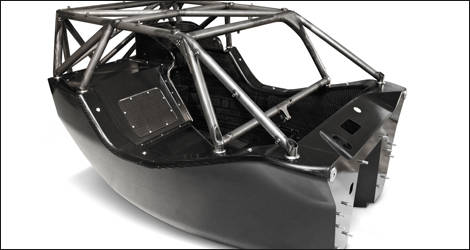 |
| This may save your life – if you're a DTM driver (Photo: Audi MediaInfo) |
The A5 DTM's monocoque is not only considerably safer, it is also incredibly light.
"The monocoque weighs only 126 kilograms, the roll-cage 32.5 kilos. At the same time the safety standards have increased dramatically. The design is extremely strong when subject to both frontal, longitudinal crashes and also side impacts. The entire sidewall must withstand a force of 360 kN in the side impact test, this equates to around 36 tones."
For those who don't speak science, that means the new car can withstand 4.5 times stronger impacts than the old generation car. From the driver's perspective, if he was to crash at 54 km/h, the forces are absorbed so well, he would only feel a load of 60 g or less on his chest.