





On this subject Bill Ford commented that, "[buyers] don't want to give up their SUVs, and we don't think they should have
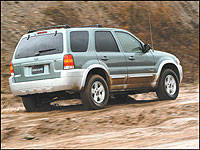 |
| Equipped with standard-fit tires, suspension and all-wheel drive (on 4x4 models), the Escape Hybrid performs just as well as the conventional Escape when the road becomes a path. (Photo: Ford Motor Company of Canada) |
Aside from entering the market at the right time, the Escape Hybrid will help boost Ford's less than shining image with national environmental agencies. The U.S. Environmental Protection Agency (EPA) recently certified the Escape Hybrid FWD at 36 mpg (U.S. gallons specified) (6.5 L/100 km) city and 31 mpg (7.6 L/100 km) highway, which is the most efficient rating any SUV has ever achieved, even better than Ford's original predictions of 35/29 mpg (6.7/8.1 L/100 km). When compared to the gasoline V6 model, the real-world difference is about 20 mpg (14.7 L/100 km), with a lesser 15 mpg (11.2 l/100 km) difference for the four-cylinder
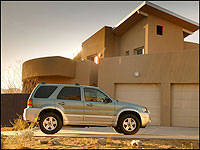 |
| A familiar exterior, SUV capabilities and a tax-cut (where available) should make the Escape Hybrid a big hit. (Photo: Ford Motor Company of Canada) |
Fuel sipping isn't the only area that the Hybrid Escape excels, as it also performs well in emissions testing. The SUV's squeaky clean powertrain releases 97 percent less hydrocarbons and nitrous oxides (NOx) than vehicles which meet the U.S. National Tier 1 Emissions Standards. Unsurprisingly, the Escape Hybrid is clean enough to qualify for the title of Advanced Technology Partial Emissions Vehicle (AT-PZEV) which is the best classification that a car can get, until hydrogen-powered zero emissions vehicles become available en masse, or one of the majors produces another full electric. Comparatively, the gasoline-only-powered Escapes, despite their advanced technologies, have little to boast about when it comes to low-emissions.