





Auto123.com presents its winter tire buyer's guide for the 2025-2026 season. Today, we present a summary of the current state of the industry. Tomorrow, we look at tires for cars and SUVs, followed by a chapter dedicated to pickup trucks.
See also: The Best Winter Tires in 2025-2026
See also: The Best Winter Tires for Trucks in 2025-2026
It's not too early
Be aware that at the time of writing, all winter tires that can be delivered have already arrived at distributors and, for the most part, at retailers. If you deal with a small merchant or your local garage, you’ll want to be ordering your winter tires as soon as possible.
And that’s because tire manufacturers have already moved on and are no longer producing winter tires for the upcoming season. If you wait, you may be left to choose from very expensive or lower-quality tires.
If you're not sure if your current winter tires are still adequate, have them examined by an expert or a specialized garage. What may still look good to you could prove ineffective in snow or on ice. Your tires might be old but not visibly worn. Have them checked to ensure they’re not too dry or at risk of blowing out.

The different tiers
Tires on offer to consumers are of various qualities. You may be familiar with the first-tier ones. They are well-advertised and belong to well-established brands. These are the ones that offer the latest technical innovations and the newest material discoveries. They are high-end tires and, naturally, they are more expensive.
So-called “second-tier” tires are, for the most part, products offered by those same major companies, but with technologies that may be less up-to-date. These are usually marketed at more affordable prices, though they’re not necessarily cheap.
There is a “third-tier’ category of tires. These too are often made by the same big companies, but their technology is often limited, and their materials are less sophisticated and less durable. They’re usually sold under another brand name.
Still, many of them are also very reliable and safe for those who drive shorter distances, generally in the city, and who aren’t necessarily looking for high technology.
“Homologated” tires
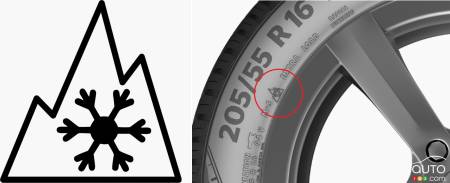
In the same vein, a new and increasingly popular technology on the market is the “all-weather” or “homologated” tire, meaning it is certified for both winter and summer. The obvious advantage with these is that there’s no need to change tires in the spring and fall.
Most of them are high-quality and manufactured by major tire makers. They all display the three-peak mountain snowflake symbol.
Studded tires
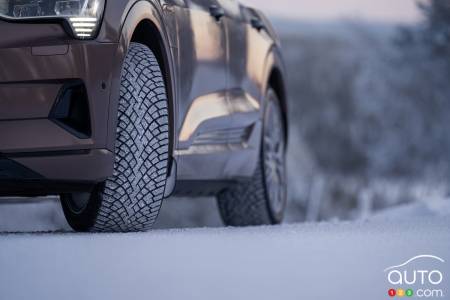
Finally, there are still studded tires on the market. However, those may be prohibited in certain areas and/or in certain areas, as well as in places like large underground parking garages with fragile coatings.
Also worth noting: many tire manufacturers produce “studless” winter tires (as seen on the sidewalls of several products where Studless is written).
Nevertheless, many manufacturers continue to produce factory-studded winter tires. By the way, if a tire is identified as “studdable,” it means the operation must be done by the distributor or the seller, and it must be done before the tire is mounted on the vehicle. In other words, you cannot drive with the tire if you choose to have it studded.
Be aware that the majority of these studdable tires are not top-tier.
Tires for electric vehicles
While many tire manufacturers declare that all of their current products are fully compatible with electric vehicles, a few winter tire makers are adding a suffix to the names of certain of their tires to specify that they meet the needs of owners of EVs.
Now, quality winter tires should perform well in general on electric vehicles. However, if some winter tire manufacturers are keen to develop an ‘EV tire’ niche, it's primarily because they want to mitigate tire noise in the vehicle's cabin as much as possible (noise being more of an issue since there’s no engine noise). The quickest solution is to add insulating foam inside the tire.
But that aside, there will be more developments needed in this field. And that’s because the current crop of new EVs carry very heavy batteries and their powertrains in many cases develop more powerful torque than their equivalents with internal combustion engines. Those factors can lead to premature tire wear. Tire makers will need to look at developing more robust and durable casings.
Check out our guide tomorrow!