





Along with the 1.8-litre inline-four that's the primary propulsion for the all-new 2006 Civic coming to market soon, Honda Canada will sell a revised hybrid version by this fall.
As is normally the case which such changes, Honda Canada says the new hybrid will deliver better performance and increased fuel economy when compared with the current system.
The New Honda Hybrid System, as its prosaically called, features a 1.3-litre inline-four engine that employs Honda's so-called "intelligent" VTEC (Variable Valve Timing and Lift Electronic Control) system to provide three stages of valve timing (low-rpm, high-rpm and cylinder-idle mode), combined with a "significantly more compact and efficient Honda IMA (Integrated Motor Assist) system."
When the engine and motor are working together, the max power ratio for the new Civic will be 115 hp at 6,000 rpm and 135 lb-ft of torque at 2,500 rpm.
Richard Jacobs of Honda Canada says the new system "employs intelligent engine functions and a more efficient IMA system to achieve an approximate 20 per cent increase in system output over the current system and the powerful performance of a 1.8-litre engine, while reducing the system size by five percent and attainting a world-leading level of emissions performance."
According to Jacobs, the 2006 Civic with the new system will thereby offer "significant improvements in both performance and fuel economy over a similarly equipped 2005 Civic Hybrid.
The 3-stage i-VTEC engine employs three hydraulic pathways to couple and uncouple five rocker arm assemblies, Jacobs explains, providing three stages of valve control depending on the driving conditions. This allows the system to achieve a combination of responsive driving and fuel economy, he says.
When the cylinders are idle during deceleration, Jacobs says, combustion in all four cylinders is halted and the cylinders are sealed shut, reducing pumping losses caused by engine aspiration for a 10 per cent improvement in recovery of braking energy compared to the current model.
In addition, he says, there have been significant reductions to friction as well, including the use of aluminum die-cast pistons, which feature low thermal expansion for less friction under high-temperature conditions, ion-plated piston rings, and plateau honing of the cylinder walls for a smoother surface.
Honda's independently developed electric motor employs coils with high-density windings and high-performance magnets to attain output 1.5 times that of the current model, while maintaining the same size.
The inverter used to control motor speed is integrated with the motor's electronic control unit for more precise digital control, says Jacobs, "contributing to even greater motor efficiency and fuel economy."
Battery output has been increased by around 30 percent over the current model, while a more compact, custom-designed battery storage box offers increased cooling performance and vibration resistance for enhanced long-term reliability.
"A dynamic, regenerative braking system hydraulically controls the brakes based on the amount of brake regeneration," Jacobs says. "This permits maximum braking regeneration along with smooth deceleration that conforms to brake-pedal pressure."
The car's air conditioning system features a hybrid compressor that is powered by both the engine and an electric motor, so when the engine is in "Idle Stop" mode the compressor is powered by the motor. If rapid cooling is required, on the other hand, it is powered by the engine and the motor combined. When the temperature is stable, it runs off the motor alone for both improved comfort and fuel savings.
As is normally the case which such changes, Honda Canada says the new hybrid will deliver better performance and increased fuel economy when compared with the current system.
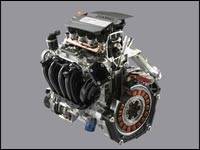 |
| (photo: Honda Canada) |
When the engine and motor are working together, the max power ratio for the new Civic will be 115 hp at 6,000 rpm and 135 lb-ft of torque at 2,500 rpm.
Richard Jacobs of Honda Canada says the new system "employs intelligent engine functions and a more efficient IMA system to achieve an approximate 20 per cent increase in system output over the current system and the powerful performance of a 1.8-litre engine, while reducing the system size by five percent and attainting a world-leading level of emissions performance."
According to Jacobs, the 2006 Civic with the new system will thereby offer "significant improvements in both performance and fuel economy over a similarly equipped 2005 Civic Hybrid.
The 3-stage i-VTEC engine employs three hydraulic pathways to couple and uncouple five rocker arm assemblies, Jacobs explains, providing three stages of valve control depending on the driving conditions. This allows the system to achieve a combination of responsive driving and fuel economy, he says.
When the cylinders are idle during deceleration, Jacobs says, combustion in all four cylinders is halted and the cylinders are sealed shut, reducing pumping losses caused by engine aspiration for a 10 per cent improvement in recovery of braking energy compared to the current model.
In addition, he says, there have been significant reductions to friction as well, including the use of aluminum die-cast pistons, which feature low thermal expansion for less friction under high-temperature conditions, ion-plated piston rings, and plateau honing of the cylinder walls for a smoother surface.
Honda's independently developed electric motor employs coils with high-density windings and high-performance magnets to attain output 1.5 times that of the current model, while maintaining the same size.
The inverter used to control motor speed is integrated with the motor's electronic control unit for more precise digital control, says Jacobs, "contributing to even greater motor efficiency and fuel economy."
Battery output has been increased by around 30 percent over the current model, while a more compact, custom-designed battery storage box offers increased cooling performance and vibration resistance for enhanced long-term reliability.
"A dynamic, regenerative braking system hydraulically controls the brakes based on the amount of brake regeneration," Jacobs says. "This permits maximum braking regeneration along with smooth deceleration that conforms to brake-pedal pressure."
The car's air conditioning system features a hybrid compressor that is powered by both the engine and an electric motor, so when the engine is in "Idle Stop" mode the compressor is powered by the motor. If rapid cooling is required, on the other hand, it is powered by the engine and the motor combined. When the temperature is stable, it runs off the motor alone for both improved comfort and fuel savings.