





The Hot Rod
The donor car for the project is a 1958 Chevrolet Apache Pickup. The previous owner left a note about its availability on the windshield of the brewery’s ‘57 Chev Pickup (aka “Grumpy”). It was love at first sight, and the team had it barged over from its resting place on Keats Island, off B.C.’s Sunshine Coast.
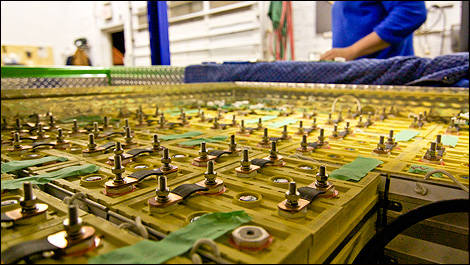
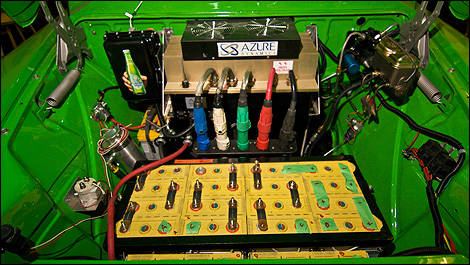
Unlike homebuilt electric vehicles, this is a high-efficiency AC powertrain, featuring the Azure Dynamics AC90 motor. This is a pretty stout motor, used for panel van conversions. For this application, it makes 465 foot-pounds of torque. It draws juice from 24 lithium batteries. It can be fully charged in eight-hours on a 220V service, good for a range of about 150 kilometres.
Battery management is crucial to a lithium ion system, and according to Kiraly, the trickiest part of the hot rod build: “Unlike other batteries, lithium ion batteries need to be balanced. They don’t like to be overcharged or to be drained. You need a system to make sure all the batteries get low together and all get charged together”.
The battery management circuit board was purchased from an Australian firm, who filed off all the labelling and notation, to make sure clients also purchase all its wiring and communication systems. But the team wanted to learn as well as build, so it “reverse engineered” the circuit boards, to be able to wire them up successfully, for the tricky battery-to-battery communication and charging functions.
Then there was a lot of experimentation with final drive systems. Like a lot of electric vehicles, Electro Retro utilizes only one gear, because electric motors make so much torque. But finding the right combination was a challenge, because the team was looking for “tire smoking power” and relaxed cruising on the highway.
The current 3.1:1 differential ratio, gives Electro Retro lots of giddy-up-and go, and a tolerable spinning rate at 90 km/h. The previous 7.8:1 differential was the one that allowed Retro Electro to burn rubber in classic dragster fashion, but it would be
basically topped at 90 km/h.
The donor car for the project is a 1958 Chevrolet Apache Pickup. The previous owner left a note about its availability on the windshield of the brewery’s ‘57 Chev Pickup (aka “Grumpy”). It was love at first sight, and the team had it barged over from its resting place on Keats Island, off B.C.’s Sunshine Coast.
 |
| Photo: Steam Whistle |
Unlike homebuilt electric vehicles, this is a high-efficiency AC powertrain, featuring the Azure Dynamics AC90 motor. This is a pretty stout motor, used for panel van conversions. For this application, it makes 465 foot-pounds of torque. It draws juice from 24 lithium batteries. It can be fully charged in eight-hours on a 220V service, good for a range of about 150 kilometres.
Battery management is crucial to a lithium ion system, and according to Kiraly, the trickiest part of the hot rod build: “Unlike other batteries, lithium ion batteries need to be balanced. They don’t like to be overcharged or to be drained. You need a system to make sure all the batteries get low together and all get charged together”.
The battery management circuit board was purchased from an Australian firm, who filed off all the labelling and notation, to make sure clients also purchase all its wiring and communication systems. But the team wanted to learn as well as build, so it “reverse engineered” the circuit boards, to be able to wire them up successfully, for the tricky battery-to-battery communication and charging functions.
Then there was a lot of experimentation with final drive systems. Like a lot of electric vehicles, Electro Retro utilizes only one gear, because electric motors make so much torque. But finding the right combination was a challenge, because the team was looking for “tire smoking power” and relaxed cruising on the highway.
The current 3.1:1 differential ratio, gives Electro Retro lots of giddy-up-and go, and a tolerable spinning rate at 90 km/h. The previous 7.8:1 differential was the one that allowed Retro Electro to burn rubber in classic dragster fashion, but it would be
basically topped at 90 km/h.
 |
| Photo: Steam Whistle |