





My first motorcycle review is finally up on Moto123.com. I’ve reviewed three-wheeled machines prior to the 2011 Honda CBR250R, like the Campagna T-Rex and Can-Am Spyder, but besides a few 50-cc scooters, I hadn’t ridden a two-wheeled bike for about 15 years.
I’ve been itching for a motorcycle since I got my license back then. But bikes aren’t cheap (relatively-speaking), have high insurance rates depending on model and displacement and, well, if you get into an accident on a bike, you WILL get hurt.
I strongly recommend taking a refresher course before getting your butt back on a bike after such a long time. What was best for me was to find a model that’s light, not too powerful and not too expensive. Opportunity knocked: Honda gladly provided us with their new 250-cc sports bike.
The CBR250R is far from intimidating, yet still provides car-like acceleration. It can consume as low as 2.9 L/100 km. Best of all, it costs only $4,499; add another $500 for ABS brakes, which isn’t a bad investment.
I needed a new helmet, a jacket and gloves. Fellow Moto123.com journalist Pascal Bastien recommended I spend a little more and get a helmet that’s certified with the Snell M2005 standard, which cost about $300 after a little negotiating. Some melon protectors were as low as $99, but I figured my brain is worth more than that. A two-layer bike jacket with protective hard-shell inserts for the back and elbows cost me another $200. I also chose a pair of $80 gloves.
But during the road test of the CBR, I realized one important thing we take for granted when we’re driving cars. On a bike, you must stay focused at all times; that’s not advice, that’s an essential rule. You must always be aware that a car or truck could cut you off at any time. You must constantly scan the road ahead for debris or potholes, and react quickly when you spot them. And if you’ve got an itch on your nose while you’re on the highway at 100 km/h, well, too bad.
In a car, we tend to daydream, listen to music too loud and get distracted by other passengers. Stupid accidents happen when we no longer focus on the road ahead. Speed kills, but singing Bohemian Rhapsody with all your might can also be lethal.
As my buddy and ex-colleague Marc Cantin once said to me: “In an accident between a car and a bike, it’s ALWAYS the motorcycle rider’s fault. He didn’t anticipate that the car could potentially run into him”. It may sound harsh, but he’s right; I’ll remember those words for the rest of my life.
There should be more motorcycles on the road; they’re fuel-efficient, their four-cycle and fuel-injected engines pollute a lot less than before, and roads would become safer for bikes if those who drive cars and trucks would be as focused as the motorcyclists are.
I’ve been itching for a motorcycle since I got my license back then. But bikes aren’t cheap (relatively-speaking), have high insurance rates depending on model and displacement and, well, if you get into an accident on a bike, you WILL get hurt.
I strongly recommend taking a refresher course before getting your butt back on a bike after such a long time. What was best for me was to find a model that’s light, not too powerful and not too expensive. Opportunity knocked: Honda gladly provided us with their new 250-cc sports bike.
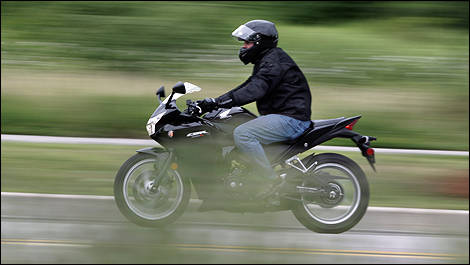
The CBR250R is far from intimidating, yet still provides car-like acceleration. It can consume as low as 2.9 L/100 km. Best of all, it costs only $4,499; add another $500 for ABS brakes, which isn’t a bad investment.
 |
| Photo: Sébastiern D'Amour/Moto123.com |
I needed a new helmet, a jacket and gloves. Fellow Moto123.com journalist Pascal Bastien recommended I spend a little more and get a helmet that’s certified with the Snell M2005 standard, which cost about $300 after a little negotiating. Some melon protectors were as low as $99, but I figured my brain is worth more than that. A two-layer bike jacket with protective hard-shell inserts for the back and elbows cost me another $200. I also chose a pair of $80 gloves.
But during the road test of the CBR, I realized one important thing we take for granted when we’re driving cars. On a bike, you must stay focused at all times; that’s not advice, that’s an essential rule. You must always be aware that a car or truck could cut you off at any time. You must constantly scan the road ahead for debris or potholes, and react quickly when you spot them. And if you’ve got an itch on your nose while you’re on the highway at 100 km/h, well, too bad.
In a car, we tend to daydream, listen to music too loud and get distracted by other passengers. Stupid accidents happen when we no longer focus on the road ahead. Speed kills, but singing Bohemian Rhapsody with all your might can also be lethal.
As my buddy and ex-colleague Marc Cantin once said to me: “In an accident between a car and a bike, it’s ALWAYS the motorcycle rider’s fault. He didn’t anticipate that the car could potentially run into him”. It may sound harsh, but he’s right; I’ll remember those words for the rest of my life.
There should be more motorcycles on the road; they’re fuel-efficient, their four-cycle and fuel-injected engines pollute a lot less than before, and roads would become safer for bikes if those who drive cars and trucks would be as focused as the motorcyclists are.