





2003 Volkswagen Eurovan - Big, Comfortable and Cool
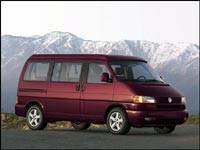
Who invented the minivan? Chrysler likes to lay claim but it was a quirky German company that first introduced the concept to North America way back in the late 1950's. The Volkswagen Microbus quickly became the automotive icon of the 60's flower power movement and later, when the camperized Westphalia model surfaced, the RV of choice for young families. Eventually, the wonderfully practical but hardly as 'cool' Vanagon replaced it, still powered by a rear-mounted, horizontally-opposed 4-cylinder engine driving the rear wheels.
Such traditions went out the sliding side door in 1992. The first Eurovan adopted a front-engine, front-drive layout and water-cooled engine, but did it fully conform? No way! First of all it was and still is big, really big. It's almost as big as a full-size domestic van and much larger than the current crop of minivans. And that's only talking size. There's way more that sets the Eurovan apart.
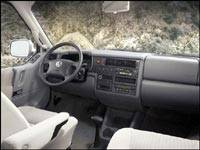
Just get inside. The Eurovan places the driver and front passenger up high in a commanding position, almost SUV-like but much closer to the windscreen. It still feels a bit bus-like, but nothing close to the original microbus or Vanagon. What has carried over from the Vanagon is the new models significant size. Its 5,833 L (206 cu ft) of interior volume surpasses every other minivan, if you can still classify the VW in this class.
Can you? While its dimensions are clearly larger than its Japanese competitors it weighs in at only 1,945 kg (4,288 lbs), slightly more than the Chrysler Town & Country at 1,935 kg (4,265 lb) but not quite as heavy as the Honda Odyssey's 1,955 kg (4,310 lbs). That's minivan territory for sure.