





• Auto123 gets in a first drive of the 2026 Toyota C-HR.
Ojai, CA - After a short absence from the market, the Toyota C-HR returns with a completely new look. Gone is the gas-powered subcompact SUV that could trace its roots back to Toyota’s Scion experiment. The 2026 model is now a 100-percent electric SUV, a more mature, more powerful and significantly more high-tech creature.
Positioned below the brand's larger EVs, the 2026 C-HR features a coupe-like design, competitive range and surprising power. Its goal is to appeal to an urban clientele looking for a vehicle that is both distinctive and versatile.
2026 Toyota C-HR - What’s new?
The C-HR is entirely redesigned and sits on the e-TNGA electric platform. This is the same architecture found in the bZ, the bZ Woodland and the future electric Highlander, though in the C-HR's case, Toyota has scaled down its dimensions.
Of particular note is the arrival of a dual-motor all-wheel-drive version developing 338 hp, capable of hitting 0-100 km/h in around 5.2 seconds. Those figures align it more with a sport SUV than a mere daily-commute car.
Another strategic element is the integration of the NACS port, granting access to a vast fast-charging network across North America. With this move, Toyota addresses one of the primary historical pain points of its early EVs.

Design of the 2026 Toyota C-HR – 8.0/10
Its wide, athletic profile, combined with a sloping roofline, gives it a more dynamic appearance than the average compact utility vehicle. To state the obvious, the 2026 C-HR bears little resemblance to the former C-HR. The profile is dynamic, as is the front with its “hammerhead” front signature and the sculpted rear section.
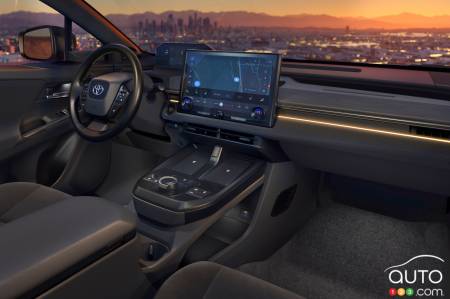
Interior of the 2026 Toyota C-HR – 8.0/10
The cabin adopts a clean presentation with slim instrumentation and an easy-to-access centre console. Soft-touch materials and customizable ambient lighting enhance the perception of quality — a significant step for an entry-level model in the electric lineup.
The space is surprising for a vehicle measuring 4,520 mm in length. The trunk offers 720 litres of space, which increases to 1,685 litres with the seats folded down.
Dual wireless chargers, rear USB ports and an available panoramic roof help make for a winning environment clearly designed for daily use.

Technology in the 2026 Toyota C-HR – 8.5/10
All trims feature a 14-inch touchscreen powered by Toyota’s in-house multimedia system, which now features Google built-in and wireless compatibility with Apple CarPlay and Android Auto. The "Hey Toyota" voice command allows for the management of navigation, climate control and audio.
Connected services include cloud-based navigation, intelligent assistant and real-time map updates. The mobile app allows users to schedule charging, pre-condition the cabin and check vehicle status remotely.
For audio enthusiasts, a 9-speaker JBL system is offered on the top trim.

Powertrain of the 2026 Toyota C-HR – 9.0/10
In Canada, the C-HR comes in two configurations. The entry-level version features a single front electric motor providing 221 hp. There’s also an all-wheel-drive model that includes a second electric motor at the rear. All models come with a 77-kWh lithium-ion battery.
Output stands at 221 hp for the FWD model, increasing to 338 hp for the AWD version.
Regarding range, Toyota has caught up to the competition. The base SE FWD version boasts 496 km. The XSE AWD with 18-inch wheels is rated at 452 km, while the XSE Premium with 20-inch wheels sits at 438 km.
Fast charging from 10 to 80 percent takes about 30 minutes under ideal conditions and battery pre-conditioning helps optimize this time in cold weather — a crucial point for the Canadian climate. The onboard charger allows for a speed of 11 kW for Level 2 home charging.
Steering wheel paddles allowing for four levels of regenerative braking adjustment add a touch of dynamic control.

Driving the 2026 Toyota C-HR – 8.0/10
The battery housed under the floor lowers the centre of gravity, which in terms engenders confidence on the road and sure handling on winding routes. Toyota has revised the springs, dampers and anti-roll bars to produce more agile behavior.
The C-HR should no longer be viewed as the cute-but-neutered SUV of old. The all-wheel-drive version goes hard with its 338 hp. Toyota has also worked on comfort levels that add refinement to the overall driving experience.
Consumption
Toyota announces consumption between 14 and 15 kWh/100 km for the FWD version. We were unable to verify these figures as our test vehicle was an AWD model. As always with an EV, real-world range will depend heavily on temperature, driving style, and accessory use. Driving conservatively on a circuit composed mostly of secondary roads, we maintained an average of around 18 kWh/100 km.

2026 Toyota C-HR – Canadian pricing
The SE FWD version starts at $44,900. Including all associated fees and charges, the total comes to $48,300 — a competitive price in this segment. The XSE AWD is $49,950 ($53,500 with fees), and the XSE Premium is $54,400 ($57,800). This is competitive pricing considering the power and equipment levels.
The final word
Toyota has completely transformed the C-HR's identity, delivering a product that is much more credible, mature and upscale than before. Faster, more high-tech and better suited to current expectations, it could become a serious player in the compact electric SUV niche. The range is now competitive, and the access to the NACS network combined with a muscular AWD version will appeal to those who want real driving dynamics — an element Toyota has sometimes put too little emphasis on for some.
2026 Toyota C-HR – Competitors
- - Chevrolet Equinox EV
- - Hyundai Kona Electric
- - Kia EV5 / Niro EV
- - Nissan LEAF
- - Subaru Uncharted (à venir)
- - Volkswagen ID.4
