


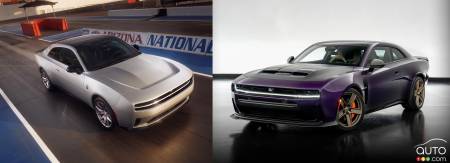



Late in 2024, with great fanfare, Dodge launched the Charger Daytona. A radical departure from what we’d seen before. For one, unlike the model it replaced, it was a coupe. But more dramatic than that, the gasoline engine was replaced by an all-electric powertrain. As changes go, that was a major one.
A year later, the American brand has enhanced its offering for the 2026 model-year by introducing the Charger Sixpack equipped with… a gasoline engine.
In fact, for models the powertrains of which are polar opposites, the Charger Daytona and Sixpack look pretty identical. But are they really? Upon closer inspection, several differences are noticeable between the two models. Auto123 took a good close look at both cars and identified seven differences.
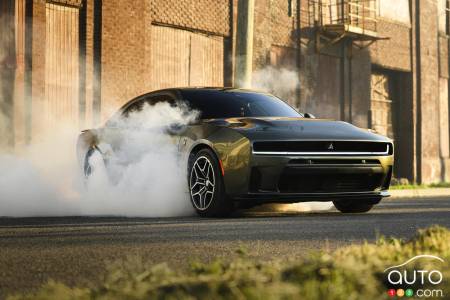
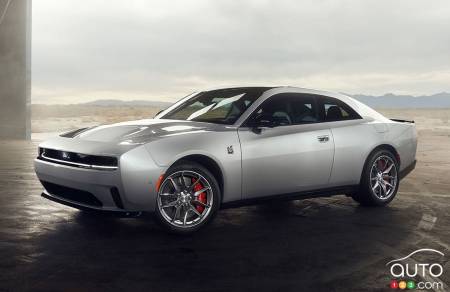
1) Obviously, the powertrains are different
Lift the hood of the two cars and you get a very different picture. In the case of the Charger Daytona, it’s all-electric and nothing but. Remember that initially, a less-powerful version occupied the entry level (the R/T), but that model has been kiboshed for 2026. Now we have the Charger Daytona Scat Pack, powered by two electric motors that produce a total output of 670 hp.
In 2026, the catalog is enriched by the addition of two gasoline-powered versions. Both Sixpack versions, R/T and Scat Pack, receive the 3.0L Hurricane twin-turbo inline-6 engine. Power is set at 496 hp for the R/T and 550 hp for the Scat Pack. Earlier this fall, Auto123 drove the 2026 Dodge Charger Sixpack on the winding roads of Tennessee.
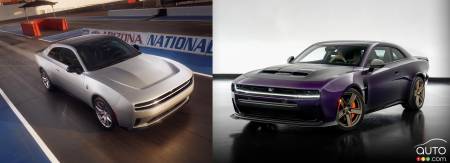
2) The hoods are different
Due in part to what’s contained beneath, the hoods of the two models aren’t precisely the same. The hood on the gas-powered Sixpack versions is higher than on the Daytona models. The difference is subtle, of course, but it becomes obvious when the cars are side by side.
And of course, the difference in height is necessitated mainly by the need for increased clearance to house the gas engine.
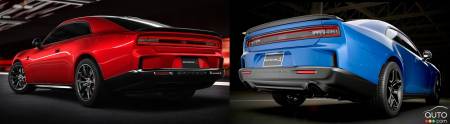
3) Rear details are different
Still on the exterior, we observe that the rear sections are quite distinctive. Naturally, the gasoline Charger Sixpack has exhaust tips while just as naturally, the electric Charger Daytona does not.
But note also that the lettering on the bottom of the rear bumper are different for the two models. The electric Charger Daytona gets DAYTONA, the non-electric gets CHARGER.
4) The badging on the dashboards is different
Sit down in the two cars one after the other, you notice certain differences as well. On the passenger side, we find DAYTONA badging on the dash, but CHARGER on all the Sixpack models.
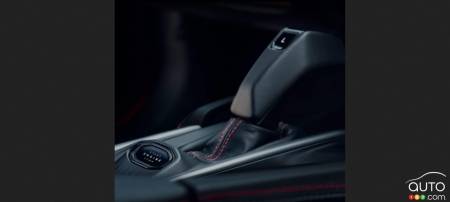
5) The gear selectors are (slightly) different
Here’s a discreet difference it would be easy to miss: Although the Charger Daytona and Sixpack are both equipped with a pistol grip-type gear selector, they are not entirely identical. How so? You’ll find an L position (for Low) on the selector of the gasoline models, but not in the electric Charger.
Some will remember that this type of gear selector could be found in Dodge (and Plymouth) muscle cars in the late 60s and early 70s. Its shape is somewhat inspired by a pistol, hence the name. This returning feature is certain to appeal to a chunk of the Charger clientele.
6) The paddles behind the steering wheel have different functions
Here’s one that actually has significance beyond esthetics. Both the Charger Daytona and the Charger Sixpack have paddle shifters behind the steering wheel. They’re thin and discreet, but they’re there.
But in fact, the paddles do different things depending on the powertrain. The paddles in the Charger Daytona are used to select the desired level of energy regeneration. In other words, you can select more or less aggressive energy regeneration depending on your needs and the driving situation.
In the Charger Sixpack, the paddles are used to select the transmission gears when manual mode is activated. Yes, the car is equipped with an 8-speed automatic transmission, so shifting gears using the paddles is not necessary or essential. However, it is appreciated by some customers who enjoy sporty driving.
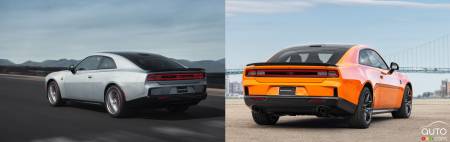
7) Their prices are different - and how!
Stellantis is using distinct commercialization strategies with the Charger Daytona and Sixpack models. Thus, by analyzing their price range, we observe that the MSRP (Manufacturer's Suggested Retail Price) differs between models.
In 2025, the Charger Daytona R/T was offered starting at $54,995. However, this model is no longer in the catalog for 2026. The base price therefore jumps to $96,790 for the Scat Pack variant, which is quite stratospheric, especially when you look over at the gasoline variant. The base R/T version of the Charger Sixpack has an MSRP of $59,995.