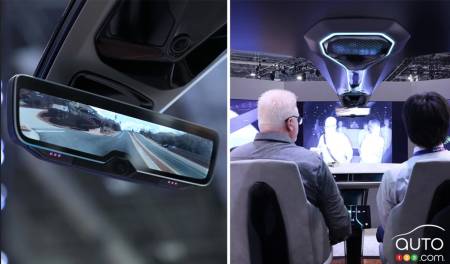



The opening days of the year have a new tradition – discovering new technologies at the Consumer Electronics Show (CES), now is in full swing in Las Vegas. Yes, the show is an opportunity to be presented with ever-smarter phones and exceptional televisions, but it’s also increasingly significant technological innovations in the automotive sector.
This year, among those showing off new tech marvels, a firm by the name of Gentex presented a rear-view mirror concept capable of acting as a true guardian angel watching over the occupants of your vehicle.
Gentex's mirror uses a camera to transform itself into a high-definition screen, coupled with a sensor capable of detecting if the driver is yawning, checking their phone or suffering a medical emergency. These systems, originally designed for luxury cars and racing, are rapidly becoming more mainstream to become central elements of on-board safety. But the innovation goes much further.
A mirror that sees further
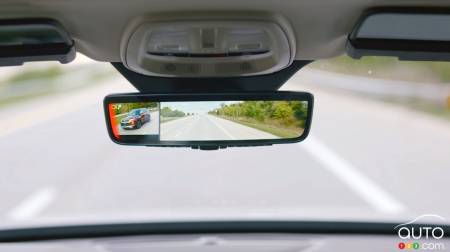
Gentex's flagship feature is the "Full Display Mirror," an interior rearview mirror capable of switching from a traditional electrochromic mirror to a panoramic LCD screen powered by a HD rear camera. In digital mode, the image is no longer obstructed by headrests, roof pillars or passengers, offering a significantly wider field of vision than a classic mirror. This type of technology is already known; notably, GM uses it on several of its models.
The system relies on a High Dynamic Range (HDR) sensor, which adjusts the exposure pixel by pixel to maintain legible details in both very dark and very bright areas — a major asset at night when facing dazzling headlights.
The version presented at CES is, however, the latest generation. It introduces advanced vision assistance functions, such as the automatic extension of the field of vision at low speeds or in reverse, a laterally expanded display to cover blind spots and monitoring of the beds of pickup trucks.
The electronic processing is based on a dedicated video processor (FPGA type) capable of managing a high-bitrate data stream, often at 60 frames per second. That reduces latency, provides a sensation of direct vision, and eliminates almost all of the motion sickness-related nausea that current digital mirrors sometimes cause.
You're being watched
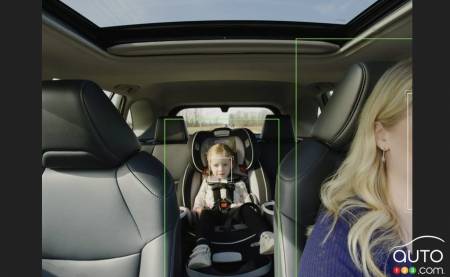
Gentex takes the concept even further by transforming this same module into a monitoring platform for the driver and the cabin. An interior-facing camera, integrated into the mirror, continuously analyses head position, gaze direction and how open the driver’s eyelids are.
Coupled with computer vision algorithms, the system can detect distraction (gaze directed towards a phone or the central screen), drowsiness (long blinks, micro-sleeps), or abnormal behaviour during the transition between semi-autonomous and manual driving.
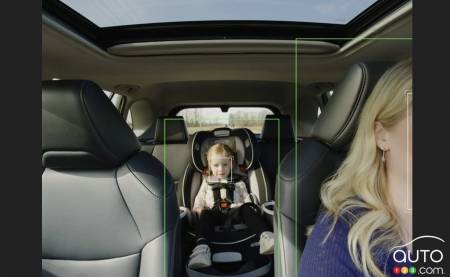
The latest demonstrators also integrate biometrics, meaning they analyse respiratory rates and micro-variations in skin tone to estimate vital signs, recognition of cognitive state (advanced fatigue, confusion) and post-collision communication. The system can automatically trigger an emergency call enriched with data on the driver's health status.
Inside the cabin, a second network of 2D or 3D sensors detects the presence of occupants, children or animals, as well as objects left on a seat. This opens the way for "forgotten occupant" alerts or an airbag deployment better adapted to the passengers' morphology.
Several manufacturers have already reportedly expressed interest in this rearview mirror integrated into the on-board safety system. The first units are expected to equip production vehicles by 2027.