


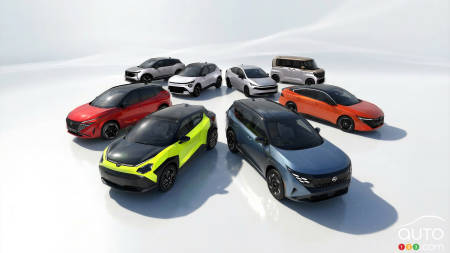



Nissan has unveiled a sweeping long-term global initiative titled “Mobility Intelligence for Everyday Life.” The strategic pivot, which comes as the "Re:Nissan" recovery plan expires, aims to streamline the brand’s global footprint. The embattled automaker is also pitching the new initiative as the path that transitions it from the phase of recovery to one of growth.
Going forward, Nissan will thus focus on drastically reducing production costs through modular platform sharing and lean heavily into both hybrid technology and artificial intelligence (AI) to regain market share by 2030.
The initiative comes at a critical time for Nissan, following a period of consolidation and the recently abandoned merger talks with Honda. Led by Nissan Americas Chairman Christian Meunier, the automaker is now betting on a disciplined approach to growth, particularly in the North American market.
See: 2027 Nissan Rogue: All in on e-Power Technology
See: Nissan Xterra Returning – But Will Canada Can It?
The rule of 45: A leaner global lineup
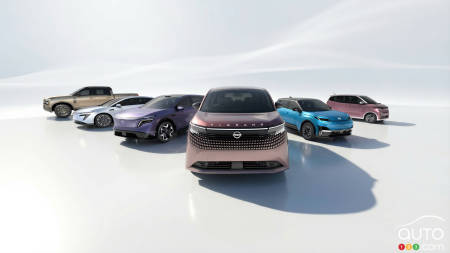
A cornerstone of the new strategy is the reduction of Nissan’s global portfolio from 61 models to just 45. To manage this leaner catalog, Nissan is subdividing its products into four distinct categories designed to address specific consumer and business needs:
- • Heartbeat: High-personality halo models intended to embody the brand’s emotional appeal (e.g., the Z, Skyline and upcoming Xterra).
- • Core: High-volume models that sustain the business (e.g., Rogue, Kicks and Qashqai).
- • Growth: Conquest models aimed at emerging demands and market share gains (e.g., LEAF and Juke EV).
- • Partner: Vehicles developed in collaboration with other manufacturers to extend market reach (e.g., Micra).
By developing three core vehicle "families" rather than isolated models, Nissan expects to increase development speed and boost individual model volumes by 30 percent while significantly cutting costs.

North America: Trucks and e-Power
For Canadian and U.S. consumers, the most significant news is Nissan’s renewed commitment to rugged, body-on-frame vehicles and advanced hybridization. At the heart of this strategy is the return of the Nissan Xterra. Targeted specifically at the North American market, the new Xterra will return to its roots as a truck-based SUV, featuring V6 and V6-hybrid powertrains to rival the Toyota 4Runner and Ford Bronco.
There are also indications that the Pathfinder may eventually return to its body-on-frame heritage to bolster this tougher image.
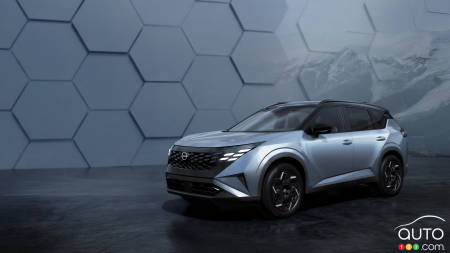
On the crossover front, the 2027 Rogue is set to be a technological centerpiece. Launching in late 2026, the next-generation Rogue will initially be offered strictly as a hybrid using Nissan’s e-Power technology. This system, which can operate in series or parallel modes, is designed to provide the smooth torque of an EV with the convenience of a gasoline engine.
Infiniti
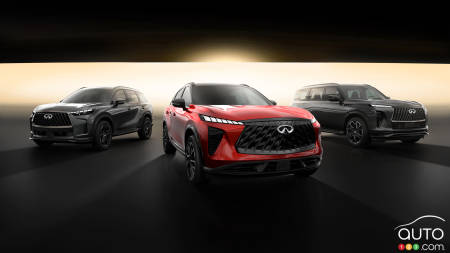
Rumours of a brand sunset have been floating about for some time, but so have indications from Nissan that it had no intention of giving up on its premium marque. The automaker again confirmed with this new initiative that Infiniti will soldier on. The strategy for the brand relies on a mix of refreshed models and new entries, including the 2027 QX65. Auto123 will be in Tennessee next week for a first drive of that coupe-style SUV, so stay tuned for that.
By the end of 2028, Infiniti will also introduce a new high-performance sports sedan (derived from the Nissan Skyline) and a luxury compact hybrid SUV, which Meunier revealed will be a premium iteration of the Rogue platform. These moves are viewed as essential for maintaining the overall profitability of Nissan Americas.
Nissan and AI
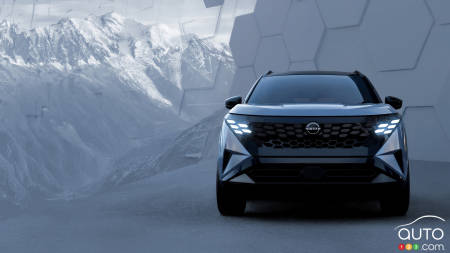
Perhaps the most futuristic pillar of the new plan is Nissan AIDV (AI Drive Technology). Nissan plans to integrate artificial intelligence into its driver-assist features, with a long-term goal of having AI-enhanced tech across 90 percent of its global lineup.
The rollout begins in the summer of 2026 with the Nissan Elgrand minivan in Japan, which will feature the next generation of ProPilot. By the end of 2027, Nissan expects to achieve significant autonomous driving capabilities. This AI-driven approach extends to the smart cabin experience and vehicle-to-everything (V2X) storage systems, allowing future Nissans to act as mobile batteries capable of powering homes or feeding energy back into the grid.
Canadian challenges
While the global outlook is optimistic, the Canadian market presents unique hurdles. Retaliatory tariffs currently in place have complicated the distribution of U.S.-built models in Canada. That has led Nissan Canada to begin paring down offerings for the Murano, Pathfinder and Frontier, which are assembled in Tennessee or Mississippi.
And that means that Canadians won’t be seeing the upcoming Xterra in our market initially, since it is primarily designed for U.S. production. Nissan will have to balance its goal of reaching one million units in North America by 2030 against these regional political complexities.
Looking toward 2030
As Nissan moves from recovery to growth, the success of this new Mobility Intelligence for Everyday Life initiative may well boil down to whether consumers embrace the brand's pivot toward high-tech electrification and rugged utility. In North America, tariff relief would also be a very welcome development.
By leveraging China as a global export hub for EVs and refocusing the Americas on high-margin trucks and hybrids, Nissan is betting that its new strategy will restore the brand to its former glory. Stay tuned.