





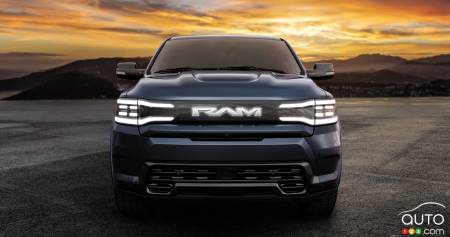
Stellantis announced this week another major postponement of the launch of its electrified pickup trucks, confirming that the 100% electric Ram 1500 will not see the light of day before the summer of 2027, as a 2028 model. This is the second postponement of the project, initially planned for 2024, then moved to 2026.
As for the extended-range hybrid Ramcharger, whose release was scheduled for 2024, its production is now pushed back to the first quarter of 2026. The manufacturer cites an extension of the quality validation period to justify this change.
A more cautious strategy than rivals Ford and GM
While Ford and General Motors have bet heavily on factories exclusively dedicated to electric pickup trucks, Stellantis has adopted a more flexible approach. At the Sterling Heights plant in Michigan, the manufacturer plans to assemble gasoline, hybrid, and electric versions of the Ram 1500 on the same production line. This strategy limits the risks associated with disappointing demand for electric pickups, a segment that is not experiencing the growth predicted a few years ago.
"Stellantis continues to reassess its product strategy in North America, leveraging our competitive advantage with the extended-range Ram, in a context of slowing demand for BEV pickup trucks," explained Jodi Tinson, Stellantis spokesperson.
Fewer losses for suppliers, but uncertainty for new contracts
For suppliers already operating at the Sterling Heights plant, the impact of the delays should remain minimal, as the production volume of gasoline or hybrid models will compensate for that of electric models.
However, suppliers who invested specifically for the electric Ram could find themselves in a delicate position. Uncertainty persists regarding the number of affected partners and the extent of investments already committed.
The boomerang effect of the electric bet at major automakers
This decision is part of a widespread decline in market expectations for EVs. Ford, for example, has seen its F-150 Lightning volumes well below forecasts, despite massive investments in its Rouge Electric Vehicle Center in Dearborn. For its part, GM is struggling to sell its Silverado EV and GMC Sierra EV and has had to slow down operations at the Orion Assembly plant.
This realignment by Stellantis, although criticized at its beginnings, now seems more adapted to the real pace of the market. A lower-exposure strategy that could prove more resilient in the long term.
A launch aiming for quality and durability
To justify the postponement of the Ramcharger, Stellantis indicated that it wanted to ensure optimal quality for this unique extended-range electric vehicle (REEV) technology. A clear sign that the manufacturer wants to avoid the launch errors observed elsewhere in the industry.